
The European Union (EU) has warned Instagram and Facebook that they must change parts of their platforms that are believed to encourage addictive behavior. If the companies fail to make improvements, they could face large financial penalties under the EU's digital rules.
The warning is part of the Digital Services Act (DSA), a major law introduced by the European Union to make online platforms safer and more transparent. The law requires large technology companies to reduce risks that may harm users, especially children and teenagers.
EU regulators believe some features on Instagram and Facebook may encourage people to spend too much time on the apps. These include endless scrolling, personalised content recommendations, auto-play videos, and notification systems that constantly encourage users to return.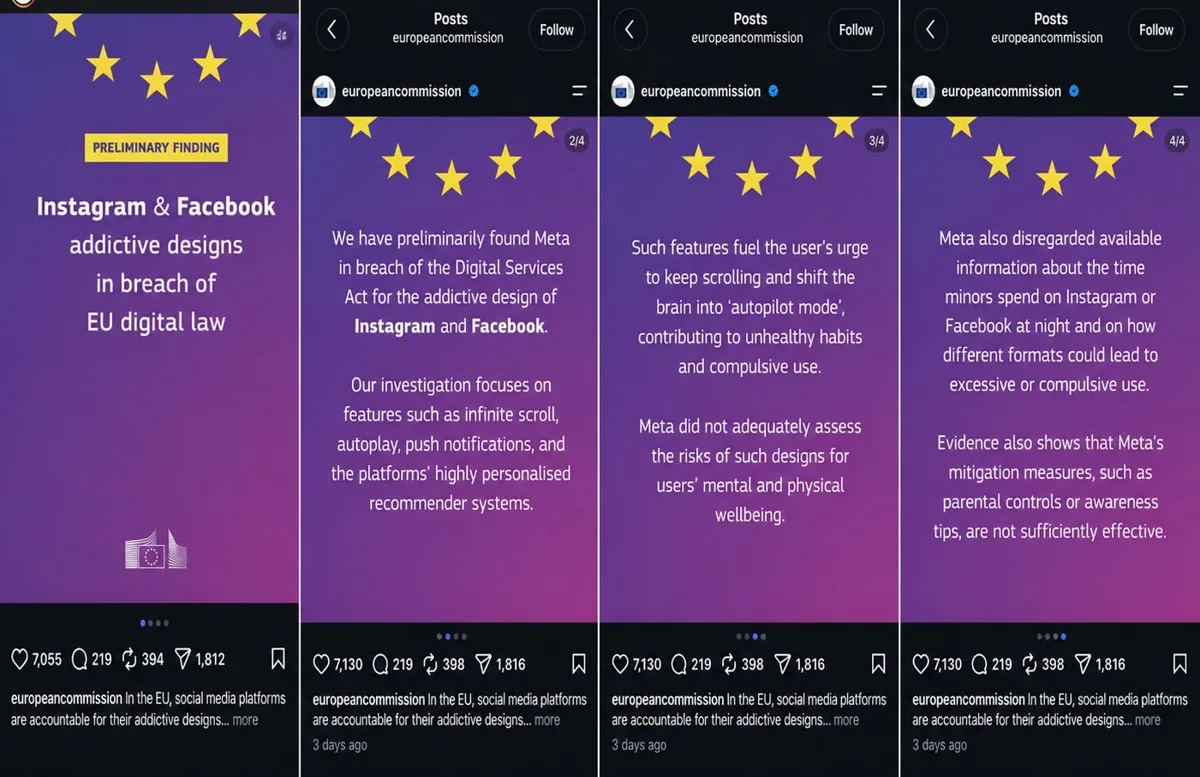
According to regulators, these features may increase the risk of excessive social media use, which can affect mental health, sleep, concentration, and overall well-being. Young users are considered especially vulnerable because they may find it harder to control the amount of time they spend online.
The European Commission has asked Meta, the parent company of Instagram and Facebook, to explain how it manages these risks and what steps it is taking to protect users. If the company cannot show that it is following the Digital Services Act, it could face significant fines.
Under the DSA, companies found to be breaking the rules can be fined up to 6% of their global annual revenue. In serious cases, regulators can also require companies to make changes to how their platforms operate.
Meta has previously said it is committed to user safety and has introduced several features designed to give people more control over their social media use. These include screen time reminders, parental supervision tools, content controls, and options to manage notifications. However, European regulators believe more improvements may still be needed.
The investigation is part of a broader effort by the European Union to hold large technology companies more accountable. In recent years, the EU has introduced several laws aimed at improving online privacy, protecting children, increasing competition, and making digital platforms more transparent.
Experts say the outcome of this case could have a major impact on the future design of social media platforms around the world. If Meta is required to change certain features in Europe, similar changes could eventually appear in other countries as well.
Supporters of the EU's actions argue that technology companies should design apps that prioritise users' health rather than simply maximising the amount of time people spend online. On the other hand, Critics warn that regulators must balance user protection with innovation and freedom for businesses to develop new digital products.
For now, Meta and EU officials are continuing discussions as the investigation moves forward. Whether the company will need to redesign parts of Instagram and Facebook remains to be answered, but the case is already being closely watched by governments, technology companies, and millions of social media users worldwide.