
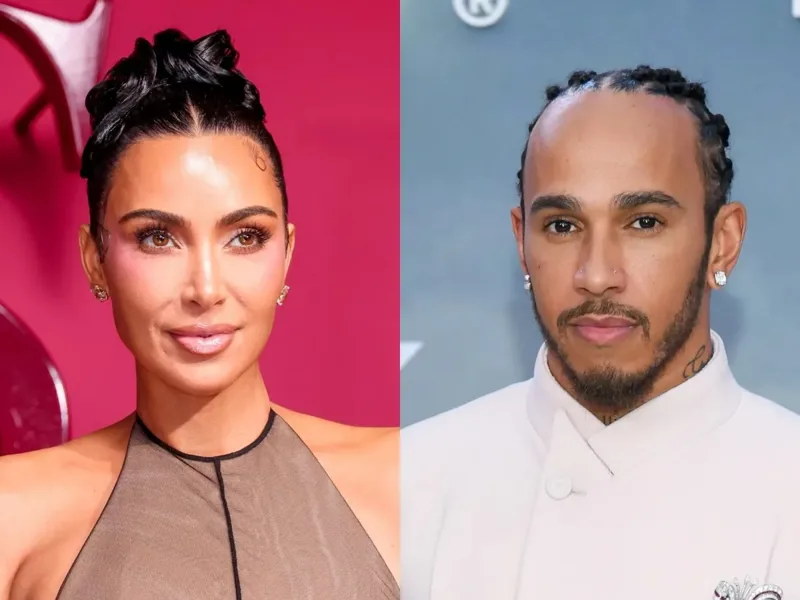
After the couple unfollowed one another, social media investigators fueled rumors of a breakup, posing concerns about performance, privacy, and the price of living in the spotlight.
Red carpets, exclusive interviews, and joint appearances no longer constitute a relationship in the hyperconnected era of celebrity culture. Social media's quiet architecture—the algorithms that monitor likes, unlikes, following, and purposeful lack of interaction—is where it lives and dies. The newest victim of intense online scrutiny is the rumored romance between Kim Kardashian and Lewis Hamilton. Astute followers have pointed to one specific act: the two no longer follow one another on Instagram. In the internet celebrity economy, that one gesture has been seen as conclusive evidence of a breakup.
The rumors have not been verified or refuted by Hamilton or Kardashian. But rather than calming the conversation, their silence has made it more lively. Timelines, recent posts, and the lack of any recent public sightings have all been examined by fans. Whispers of a developing romance have given way to speculations about what went wrong, who started the breakup, and whether the relationship was ever really serious. The unique paradox of contemporary stardom is that, despite constant demands for privacy, every obscure social media move invites intrusive interpretation.
However, it's possible that the rumors reveal more about our shared desire for story than they do about Hamilton and Kardashian. Both Hamilton, the seven-time Formula One champion whose every move is scrutinized not only for speed but also for personality, and Kardashian, who has amassed an empire via the meticulous curating of her personal life, are used to living in the spotlight. There was always going to be interest in the possible coupling of the racing veteran and the reality TV mogul. It symbolized the confluence of two worlds: British sports nobility and American media prominence, entertainment and sport. For many, the story of its potential demise—real or imagined—is more captivating than either person's career accomplishments.
Beneath the rumors, however, is a more unsettling reality. We forget that these are real lives, complete with the messiness of genuine human connection, while we devour celebrity relationships like stories in a serialized drama. Hamilton, who has been outspoken about mental health and the demands of elite competition, and Kardashian, who has managed a highly publicized divorce from Kanye West and the challenges of co-parenting, are not players in a narrative that we have a right to know. They are individuals dealing with the typical difficulties of intimacy in unusual circumstances.
The unfollow itself is a curious ritual in the celebrity playbook. It is a gesture that carries weight precisely because it is deliberate. Following someone on Instagram is a low-commitment action—a tap that requires almost no effort. To undo that tap is to make a statement. But it is a statement that remains frustratingly ambiguous. Does it signal a breakup? A private disagreement? A decision to shield a fragile connection from public consumption? Or, perhaps, a simple cleaning of a digital space that no longer serves a purpose?
The rumors will continue if there is no confirmation. Instagram activity will continue to be analyzed like religious scriptures, and rumors will transform into "sources close to the couple." This is the environment that Hamilton and Kardashian live in, where absence is seen as proof and quiet is misinterpreted as admittance. However, acknowledging that we don't know is perhaps the most profound way to respond to these rumors. We are unable to know. Perhaps this ambiguity is a failing of our communal boundaries rather than a failure of journalism in a world where privacy is becoming more and more scarce.
For the time being, as the world looks on, Kim Kardashian and Lewis Hamilton will carry on with their lives, racing, creating empires, raising kids, and negotiating the maze of human emotion. New conjecture, theories, and unfollows will take the place of the rumors as they fade. However, the more profound query remains: How much does it cost an individual to have every silent choice scrutinized, every digital gesture examined, and every private moment turned into public property? Maybe everything is the answer.