
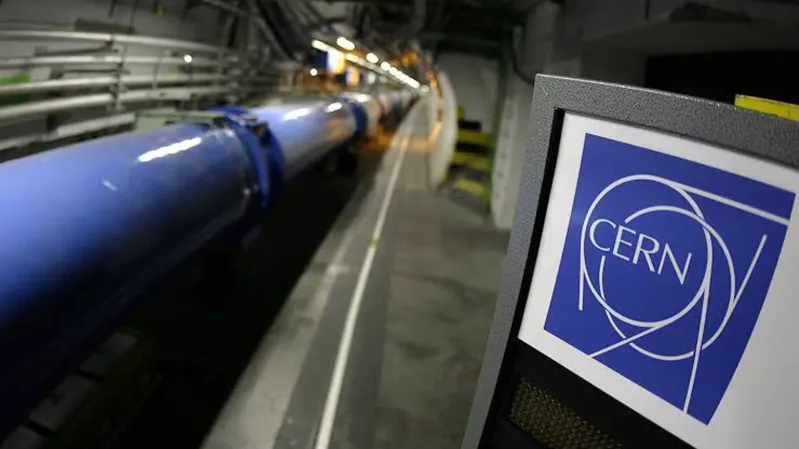
The Large Hadron Collider (LHC), which is the world's biggest and most powerful particle accelerator, has been temporarily shut down as scientists begin a major four-year upgrade. The project is expected to make the machine even more powerful and improve its ability to study some of the biggest mysteries of the universe, including dark matter.
The LHC is located at CERN, which is the European Organization for Nuclear Research, near Geneva on the border of Switzerland and France. It is a 27 km underground ring where scientists accelerate tiny particles to nearly the speed of light before smashing them together. These collisions help researchers understand how the universe works at its most basic level.
The collider is famous for helping scientists discover the Higgs boson, also known as the "God Particle," in 2012. That discovery confirmed an important part of modern physics and earned the 2013 Nobel Prize in Physics for the scientists who predicted its existence.
Now, CERN is preparing the LHC for its next chapter. During the shutdown, engineers will replace old equipment, install more advanced magnets, improve detectors, and upgrade the collider's systems. These changes are designed to allow the machine to produce many more particle collisions than before.
The upgraded collider will collect much larger amounts of data once it returns to operation. This will give scientists a better chance of spotting extremely rare particles and interactions that could reveal new physics beyond what is currently known.
One of the biggest goals of the upgrade is the search for dark matter. Although scientists believe that dark matter makes up around 85% of all matter in the universe, it has never directly been detected. It cannot be seen with a telescope because it neither emits nor reflects light, but its presence is believed to influence the motion of galaxies through gravity.
Researchers hope that the upgraded LHC could provide clues about what dark matter is made of or uncover new particles that existing theories cannot explain. Even if dark matter is not found directly, the new data could help scientists eliminate certain theories and move closer to the answer.
The four-year shutdown will also allow teams to carry out maintenance work that keeps complex machines running safely and efficiently. Thousands of scientists, engineers, and technicians from around the world are involved in the upgrade project.
Although the collider will remain offline during the upgrade period, research at CERN will continue using existing data and other experiments. Once the LHC is upgraded and turned back on, scientists expect it to open a new era of discoveries that could reshape our understanding of the universe.
The Large Hadron Collider is expected to be one of the most advanced scientific instruments ever built after the improvements. It will give researchers an even better opportunity to explore hidden secrets of space, matter, and the forced that shape everything around us