
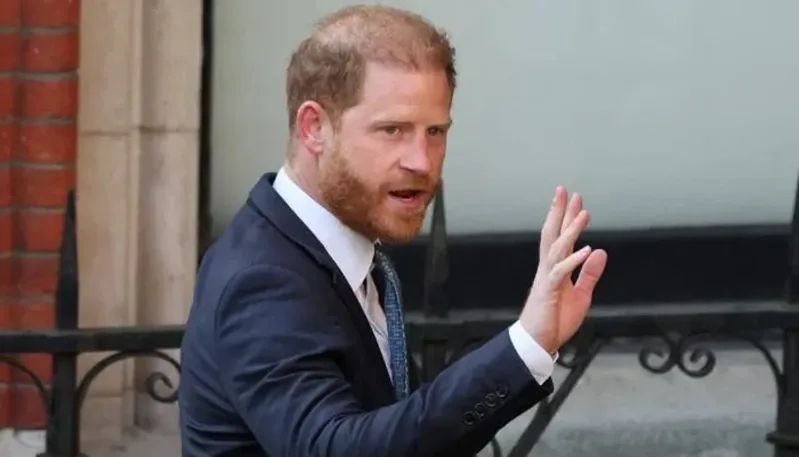
Prince Harry has long viewed the courtroom as a battlefield, where he fights a press that he believes is to blame for both his mother's passing and his wife's unrelenting persecution. That war took a big hit on Tuesday. In a decision that highlighted the discrepancy between fury and facts, London's High Court dismissed his privacy claim against Associated Newspapers, the publisher of the Daily Mail and the Mail on Sunday.
The 41-year-old Harry was in Britain when the ruling was made. He had presented this action as a "public duty"—a campaign against what he perceives to be systematic abuse by the British tabloid press—rather than as a personal grudge. He had testified in January, clearly upset and finding it difficult to contain his tears as he explained how Meghan's life had been "an absolute misery" due to the Daily Mail. He was accompanied by seven other prominent individuals, including Sir Elton John, who all claimed that dozens of stories published between the 1990s and 2011 were based on material obtained illegally, such as through blagging, phone hacking, or private detectives.
However, Associate Newspapers vigorously retaliated, calling the accusations "smears." The court concurred. In his summation, Judge Matthew Nicklin made a clear and moral decision: suspicion, no matter how strong, is not proof. The claimants were unable to prove that the data in those articles had been obtained illegally. The judge dismissed the claim that the stories had to have been sourced illegally just because the information was confidential and the publication was unable to provide a definitive explanation. To put it another way, a lack of explanation does not always imply guilt.
It was a "overwhelming victory" for the publisher. It was a painful loss in a protracted and intensely personal struggle for Harry. He had already resolved a dispute with Rupert Murdoch's news division and triumphed over the publisher of the Daily Mirror. However, this setback is noteworthy both legally and symbolically. It implies that the basic criterion of proof cannot be circumvented, even by a prince armed with grief, grievance, and the weight of public sympathy.
However, it's possible that this decision has deeper implications for people other than Harry. It compels an uncomfortable question to be faced: What does justice really require in a time of suspicion, when confidence in institutions is brittle and accusations spread more quickly than facts? Judge Nicklin reminded us that the law requires more than gut feeling. It requires evidence. The innocent are shielded from the tyranny of mere suspicion by that norm, even if it can feel chilly, particularly to those who have suffered. Harry's battle goes on. However, this ruling serves as a reminder that even justified rage must abide by the norms of evidence.