
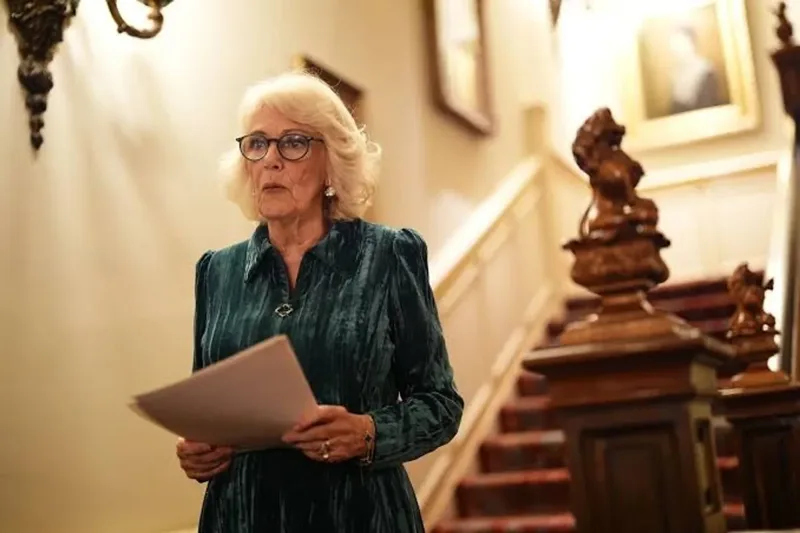
Queen Camilla’s reading campaign is moving from the festival stage to television, with a BBC documentary expected next month after fresh details were unveiled at Chatsworth over the weekend. The programme will explore the part books have played in people’s lives, giving the Queen’s long-running literary project a new audience beyond its online book club.
The Book That Changed My Life is expected on BBC Two on October 14, subject to confirmation in the weekly schedules, according to PA’s report in The Independent. The September announcement adds details to a project Camilla first discussed in March; it should not be confused with a documentary that is already available to watch.
What the documentary will show
The BBC Arts film follows Camilla meeting four people who describe finding something important in books at difficult moments. Its contributors include Ian Kirby from Gateshead, whose experience was discussed during a festival session led by novelist Ann Cleeves. Kirby describes a local book club and the autobiography of boxer Glenn McCrory as important to his recovery after depression.
PA also reports that Kirby joined the Reading Ramblers, a group combining books and audiobooks with walks in Chopwell Wood. His story gives the film a concrete subject: the relationship between reading, conversation and companionship. These are personal experiences, rather than a promise that the same activity will produce the same outcome for every viewer.
The four books Camilla chose for autumn
Camilla attended the opening day of The Queen’s Reading Room Festival on September 19. The event ran across September 19 and 20 at Chatsworth in Derbyshire, so readers discovering the story on Monday are seeing a report on the completed weekend, not an invitation to a forthcoming festival.
At the event, she unveiled four autumn choices: Finding Belle by Reeta Chakrabarti, The Picture of Dorian Gray by Oscar Wilde, Whistler by Ann Patchett and Sashenka by Simon Sebag Montefiore. ITV’s coverage records the list and Chakrabarti’s response to seeing her novel selected.
The choices provide a straightforward way to follow the campaign after the festival. A reader can start with one title, compare reactions with a friend or local group, and use the selection as a point of discussion. There is no reason to treat a royal reading list as a test of literary knowledge or an obligation to finish every book.
A festival with a wider literary programme
According to Chatsworth’s official programme, the weekend’s subjects extended from Harlan Coben’s work for Netflix to Elif Shafak’s fiction and William Boyd’s approach to literary thrillers. The range helps explain the festival’s reach: it connects books with screen adaptations, storytelling and the practical choices writers make.
The charity’s own programme also included a Writers’ Room with advice from people working in publishing, alongside poetry and book-club spaces. Those activities offer a different route into reading from a formal author interview. Someone drawn by television, performance or the ambition to write can encounter books through an interest they already have.
What happens beyond the royal appearance
The Reading Room’s grassroots account describes partnerships with St Mungo’s, The Elm Foundation and Chelsea and Westminster Hospital. It reports donating more than 2,300 books across its work and developing shared-reading activities for people experiencing homelessness, survivors of domestic abuse and hospital patients. These are the charity’s reported activities, not an independently measured outcome for every recipient.
A digital toolkit developed by Opening the Book helps staff and volunteers create welcoming conversations around literature. The practical emphasis is on access: books must be available, and people need a setting where they feel comfortable discussing them. A donation can supply reading material; staff support can help someone use it.
There is further detail in the charity’s June account of its St Mungo’s partnership, which describes bookshelves in nine London accommodation services and books selected by clients and staff. That involvement matters because a reading space is more likely to feel relevant when the people using it have a say in its contents.
For viewers, October’s expected broadcast is the next clear date to watch. For the campaign itself, the more lasting question is whether attention from the Queen, the festival and the film brings people into reading communities that continue after the cameras leave.