
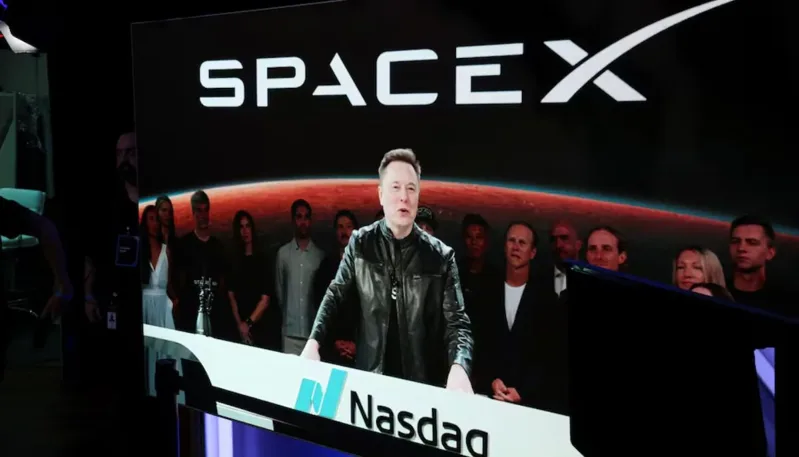
For the first time in more than two decades of existence, SpaceX had to show Wall Street its actual numbers — and by the headline figures, it delivered. The company reported $7.81 billion in second-quarter revenue, comfortably ahead of the $6.93 billion analysts expected, with a loss of just 9 cents per share against a forecast loss of 26 cents. Revenue was up 92% from $4.1 billion a year earlier. On paper, that's not a company struggling to justify its valuation — it's one growing faster and losing less money than the market had priced in.
And yet the stock fell in after-hours trading anyway. That disconnect is the real story here, and it says more about where SpaceX stands as a public company than the headline beat does.
A Trillion-Dollar Bet Meets Its First Reality Check
SpaceX's June IPO was the largest in history, pricing at $135 a share and raising $85.7 billion, with shares briefly touching $225.64 within days as investors piled into the most anticipated listing in years. Since then, the stock has been in near-constant retreat — down more than 45% from that peak, trading around $120 heading into Tuesday's report, having shed roughly a quarter of its value in the month before earnings alone. By some estimates, the slide has erased close to half a trillion dollars in market value.
The reason isn't that SpaceX is failing. It's that SpaceX priced in at nearly 49 times expected revenue on the promise of three simultaneous, capital-hungry bets: Starlink's satellite internet business, the Starship program, and — increasingly central to the pitch — an AI infrastructure and compute business competing for the same hyperscaler dollars as Nvidia, Microsoft, and Google. Investors who bought at IPO pricing weren't betting on a rocket company. They were betting on all three story lines paying off at once, and Tuesday's report was the first chance to check that bet against actual financial discipline.
What the Beat Doesn't Answer
The revenue and loss numbers look strong, but they sidestep the two questions that have actually been driving the sell-off: capital expenditure and cash burn. SpaceX is simultaneously funding Starlink's global expansion, Starship's ongoing test program — including a planned first-ever tower catch of a Starship upper stage in the next flight window — and a fast-scaling AI compute business anchored by deals like its reported $920-million-a-month Google Cloud compute arrangement. Each of those alone would strain most companies' balance sheets; running all three in parallel is precisely what has investors watching capital expenditure and free cash flow more closely than the top line. Early indications suggest capex came in heavy again this quarter, which is likely what kept the stock under pressure even after the headline beat.
There's also a governance wrinkle sitting in the background: a lock-up expiration freeing up to 20% of shares for sale is looming, and investors are wary that added supply will keep pressuring the stock regardless of how the underlying business performs — a reminder that post-IPO stock moves aren't always a pure referendum on fundamentals.
Why This Matters Beyond Silicon Valley
SpaceX's earnings are being read as a proxy for a much bigger question hanging over markets globally: whether the AI infrastructure buildout — the trillions of dollars flowing into compute, data centers, and satellite-linked connectivity worldwide — is producing businesses that can actually convert growth into cash, or whether the sector is running on narrative faster than balance sheets can keep up. That question doesn't stay contained to Nasdaq. Starlink's own footprint now spans 164 countries with over 10 million subscribers, including expanding connectivity services relevant to markets with limited terrestrial broadband infrastructure, so the pace and profitability of that expansion has real implications well beyond US investors.
For now, Wall Street's own positioning tells the story better than any single metric: seven buy ratings, three holds, one sell, and a consensus price target implying nearly 100% upside from current levels — analysts who still believe in the long-term thesis, watching a market that, on its first real chance to judge the numbers, chose caution over conviction.