
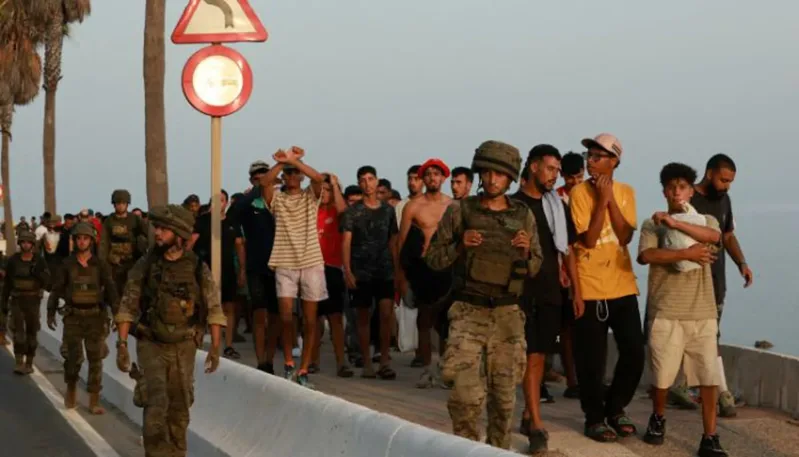
A packed dinghy carrying more than 160 people caught fire and began sinking in the English Channel on Tuesday, triggering a joint British-French air and sea rescue that pulled everyone aboard to safety — one of the largest single-boat rescue operations of the year, and a stark reminder that the UK's migration debate isn't cooling down even as the official numbers say it should be.
According to French officials, around 162 people were on board when the engine caught fire. Five had already been rescued earlier and returned to Boulogne after a separate incident; the rest chose to press on toward Britain before the fire forced the full-scale rescue. The Royal National Lifeboat Institution deployed an all-weather lifeboat at 6 a.m., working alongside UK Border Security and French vessels until all 157 remaining passengers were recovered. It was the second-largest single-boat crossing attempt of the year, trailing only a July 23 crossing that carried roughly 165 people.
Reform UK Moves Fast — With a Navy-Led Plan
The political reaction arrived within hours. Reform UK, the right-wing party led by Nigel Farage, seized on the incident to revive its call for "Operation Fortress" — a proposal to use the Royal Navy to intercept Channel crossings and return migrants directly to France and Belgium. Farage framed it as a rescue-and-return model rather than a purely punitive one, arguing on social media that the plan would prevent deaths rather than cause them. A fellow Reform politician echoed the framing, describing the approach as the "humanitarian" alternative to the status quo of small-boat crossings continuing largely unimpeded once at sea.
The proposal isn't new — Reform has floated naval turn-backs before — but Tuesday's fire gave it fresh urgency as a talking point, tying a dramatic, photogenic rescue directly to the party's core pitch on border security.
The Numbers Tell a More Complicated Story
Here's where the politics gets genuinely interesting: the crossings data doesn't actually support the "crisis is spiralling" narrative Reform is using it to build — and it doesn't fully support Prime Minister Andy Burnham's "progress is being made" line either.
The hard numbers, drawn from provisional Home Office-linked figures reported this week: roughly 14,526 people have crossed the Channel in small boats so far in 2026, a 43% drop from the 25,436 recorded at the same point in 2025, and 14% lower than 2024. Burnham has leaned heavily on that comparison, calling it evidence that Home Secretary Shabana Mahmood's crackdown measures are working, and pointing to July's crossing total as the lowest for that month in six years.
But the same week produced the UK's single busiest crossing day of 2026 — 752 people arriving in one day — and more than 2,000 migrants have crossed since Burnham took office on July 20 alone, barely two weeks into his premiership. That's almost identical to the 1,962 who crossed in the same window a year earlier, meaning Burnham's own honeymoon period has tracked essentially flat against the year he's using as his comparison baseline.
That contradiction — falling annual totals alongside record single-day spikes and a flat start under the new PM — is exactly the gap Reform is exploiting. Statistically, Burnham has a real argument. Politically, a burning dinghy and a 752-person single-day record make for far more powerful images than a percentage decline in a government spreadsheet.
Why the Framing Fight Matters More Than the Fire
The deeper story here isn't really about one boat. It's about how two competing, technically-true data readings are being weaponised in real time to build opposite political cases — one about a crisis spinning out of control, one about a plan quietly working — while the people actually on these boats remain largely absent from the debate beyond being counted. Whichever framing wins in the coming weeks will shape not just Reform's political momentum heading into the next electoral cycle, but the pressure Burnham faces to escalate toward exactly the kind of naval intervention model Reform is now pushing.