
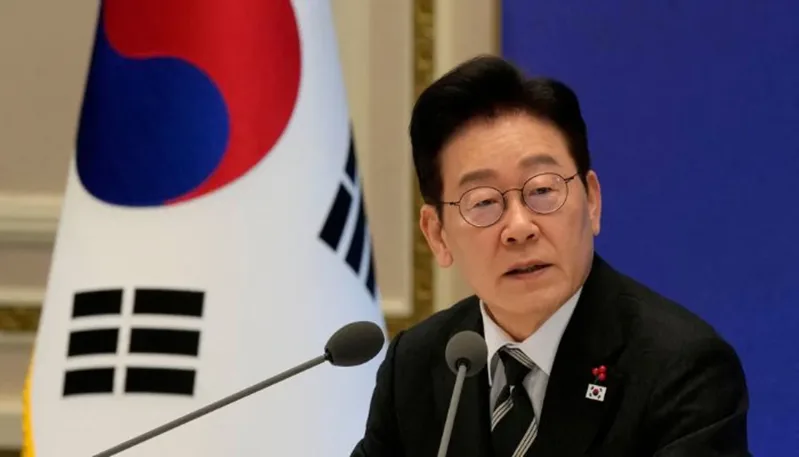
South Korean President Lee Jae-myung used his Liberation Day address Saturday to propose something no South Korean leader has managed to deliver in more than seven decades: formal talks with North Korea to end the Korean War outright, replacing a 73-year-old ceasefire with an actual peace treaty. "Let us put down our intentions to threaten each other and begin discussions to end the long-running war as the directly involved parties," Lee told a crowd of roughly 3,000 gathered in Seoul, including independence-movement families, foreign ambassadors, and government officials, on the anniversary of Korea's liberation from Japanese colonial rule.
Why the Koreas Are Still, Technically, At War
The core legal fact driving this story rarely gets explained clearly, and it's worth doing so: the 1950-53 Korean War never actually ended. It stopped — via the 1953 armistice agreement, a ceasefire signed by military commanders, not a peace treaty signed by heads of state. That distinction isn't just semantic. An armistice suspends fighting without resolving the underlying conflict, leaving both Koreas in a legal state of continued war for the past 73 years. Every subsequent flare-up along the Demilitarized Zone — artillery duels, naval skirmishes, propaganda balloon exchanges, and periodic troop movements — has occurred within a technically still-active war, not a resumed one. Lee's proposal is an attempt to finally close that legal gap, not merely improve relations at the margins.
A Genuine Shift From His Predecessor
Lee's overture is also a real reversal of South Korean policy, not just rhetorical continuity. He took office in June 2025 after his predecessor Yoon Suk-yeol was impeached and removed following an attempted declaration of martial law — a domestic crisis that itself shook South Korean politics and briefly rattled financial markets. Where Yoon pursued a hawkish, pressure-first approach toward Pyongyang, Lee has consistently pushed reconciliation since taking power, going as far as offering talks with North Korea without preconditions. In July, South Korea's own unification minister signaled Seoul had effectively dropped its longstanding insistence that any dialogue be conditioned on North Korea first agreeing to dismantle its nuclear weapons — a significant concession in negotiating posture, whether or not Pyongyang chooses to test it.
The Reception Problem
Here's where the story gets genuinely difficult, and where a lot of coverage understates the obstacles: North Korea has given Seoul very little reason to expect a warm response. Pyongyang has remained largely unresponsive to reconciliation efforts throughout Lee's presidency so far, and the broader trend line points the opposite direction from de-escalation. North Korea has repeatedly declared itself an "irreversible" nuclear state — a formal doctrinal position adopted since the 2019 Trump-Kim summit in Hanoi collapsed over denuclearization scope and sanctions relief, meaning Pyongyang no longer frames its nuclear arsenal as something on the table for negotiation at all, let alone as a starting point for talks.
The regional backdrop compounds the skepticism. This same week, North Korea denounced upcoming annual US-South Korean joint military drills and warned of stronger deterrence measures in response. Pyongyang has also grown increasingly agitated by Japan's gradual military buildup — Tokyo has pledged to expand its defense capabilities with what it called a "sense of urgency and crisis" — and has answered with missile tests, firing off two in as many weeks. Layered on top of that, North Korea has been deepening its relationship with Russia, a partnership that has given Pyongyang both diplomatic cover and, by multiple intelligence assessments, technology transfers benefiting its weapons programs — reducing Pyongyang's economic and strategic dependence on exactly the kind of diplomatic opening Seoul is now offering.
There's also historical precedent for how North Korea tends to respond to exactly this kind of overture. Kim Yo-jong, the influential sister of Kim Jong-un who frequently serves as Pyongyang's de facto spokesperson on inter-Korean matters, has previously responded to South Korean proposals for a war-ending declaration by setting her own conditions first — typically demanding the South abandon what Pyongyang characterizes as "hostile policy" and "double standards" before any talks proceed. That pattern suggests Lee's proposal, however genuine, is more likely to be met with a counter-demand than an acceptance, at least in its opening exchange.
Why It's Worth Taking Seriously Anyway
None of that skepticism means the proposal is empty gesture. Formally ending a 73-year-old war carries real stakes beyond symbolism: it would reshape the legal basis for the roughly 28,500 US troops still stationed in South Korea under the armistice framework, alter the mandate of the United Nations Command that has technically overseen the ceasefire since 1953, and could open space for sanctions and security discussions that a state of active war forecloses by default. Lee's call for a "multilayered security system" to manage DMZ tensions and prevent crisis escalation is, in that light, less a naive peace gesture and more an attempt to build durable guardrails around a relationship that has spent seven decades one incident away from renewed conflict.
Whether Pyongyang engages at all — and on what terms — will be the real test of whether this moment becomes a genuine inflection point in Korean Peninsula diplomacy or another entry in a long list of unanswered Seoul overtures. For now, the proposal exists; North Korea's response does not.