
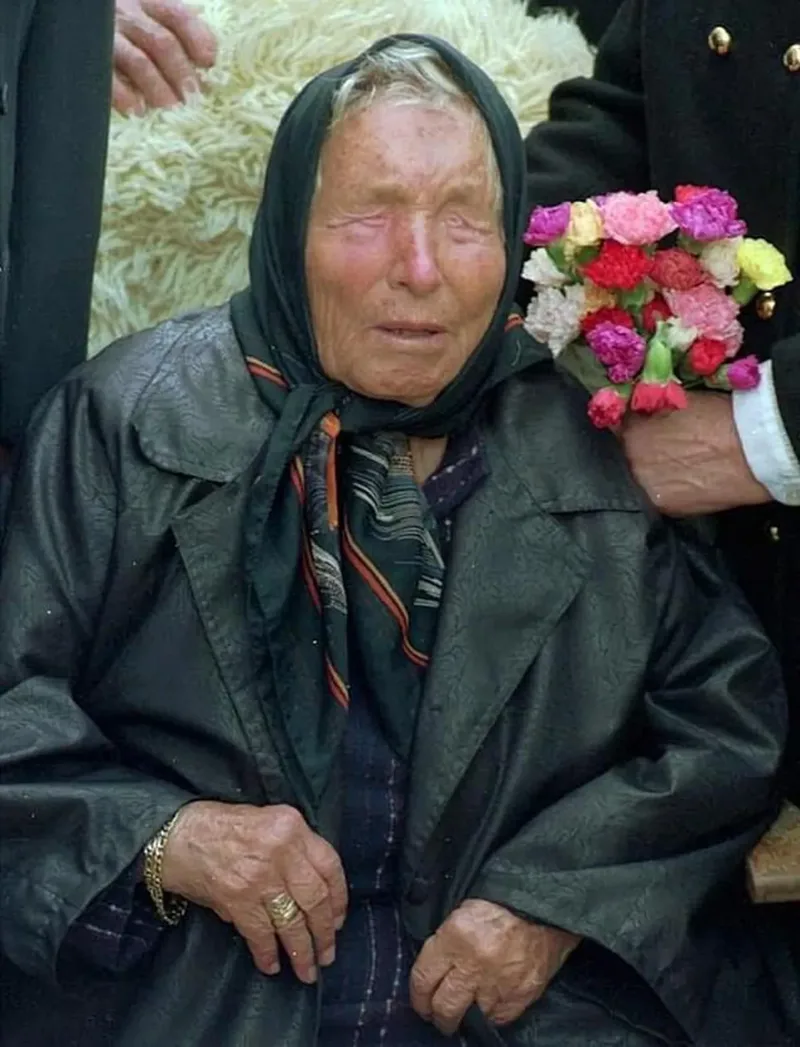
Every January, the same ritual plays out online: a fresh batch of world-ending prophecies attributed to Baba Vanga, a blind Bulgarian mystic who died in 1996, starts circulating across social media and tabloid outlets. This year's list — World War III, an alien spacecraft entering Earth's atmosphere in November, Vladimir Putin's downfall, a global financial collapse — is drawing particular traction, partly because it happens to line up with real anxieties already in the news: rising China-Taiwan tensions, the Russia-Ukraine war, and ongoing speculation about the interstellar object 3I/ATLAS. That overlap is doing most of the work in making the predictions feel eerily current, and it's worth understanding why.
What's Actually Being Claimed
According to the various outlets recirculating them this year, Baba Vanga's 2026 forecasts include: the outbreak of a world war beginning in the East and drawing in the US, Russia, and China; a massive alien spacecraft entering Earth's atmosphere in November; a new, more powerful Russian leader emerging after Putin's fall; continued global economic instability; earthquakes, wildfires, and other natural disasters affecting up to 10% of the planet; and AI beginning to fundamentally reshape commerce and daily life. She's also credited with predicting synthetic organ manufacturing will start scaling up around 2046, and — per her own supposed timeline — that the world itself won't end until the year 5079.
The Problem: None of This Comes From Vanga Herself
Here's the detail that gets lost in every recirculation: Baba Vanga left no written record of these predictions. She was illiterate and gave oral readings to visitors throughout her life; what exists today is a patchwork of secondhand accounts, later books written by admirers and family members, and decades of retrospective reinterpretation — much of it assembled and popularized well after her death in 1996. There is no verifiable primary source for most of the specific claims now being attributed to her for 2026, which makes the entire list functionally unfalsifiable: impossible to confirm she said it, and just as impossible to disprove.
That's compounded by how vague the "hits" attributed to her actually are. Her supposed 9/11 prediction — "American brethren will fall after being assaulted by steel birds" — is frequently cited as proof of her powers, but it's also exactly the kind of broad, symbolic phrasing that can be retroactively mapped onto almost any large-scale disaster involving aircraft or falling structures. This is a well-documented psychological pattern sometimes called the Barnum effect: vague, generalized statements feel personally or historically specific only after an event has already happened and people go looking for a match. It's the same mechanism that makes horoscopes feel accurate.
It's also worth noting what doesn't get repeated in these annual roundups: Vanga's track record includes plenty of specific, checkable misses — including a series of failed predictions about the 2020s that rarely resurface once the year in question has passed without incident. Recirculated "predictions" lists tend to survive through selective memory: the vague hits get amplified, the specific misses quietly drop out of rotation.
Why the Story Keeps Coming Back Anyway
None of this makes the phenomenon itself uninteresting — it just relocates the real story. The genuinely notable thing here isn't whether Baba Vanga foresaw 2026; it's why unfalsifiable prophecy content reliably goes viral at the start of every year, particularly during periods of real geopolitical and economic anxiety. Vague warnings about war, disaster, and instability resonate hardest precisely when people are already worried about war, disaster, and instability — the predictions aren't informing public anxiety so much as reflecting it back, dressed up as foresight.
That's a pattern worth naming on its own terms, separate from any individual mystic's reputation: uncertain times reliably produce a market for the feeling of foresight, whether or not any actual predictive claim is being made. Baba Vanga is simply this era's most recognisable name attached to that market.