
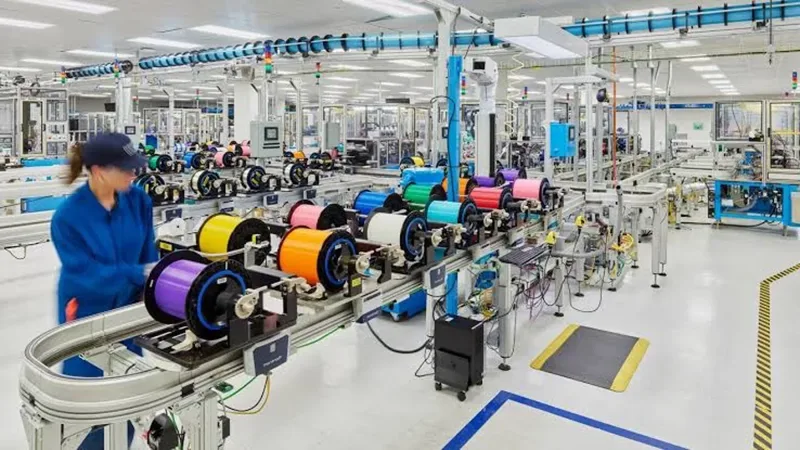
Prysmian and Rio Tinto announced on September 18 that electrical cables made using ELYSIS aluminium have been contracted for installation at an Amazon data centre near Columbus, Ohio. The agreement gives a developing aluminium technology a specific application in infrastructure built to carry power.
Prysmian describes it as the first known use of aluminium smelted with inert-anode technology in a data centre. That is the supplier’s claim. The announcement concerns a contracted installation; it should not be read as confirmation that an entire data centre is already operating with zero emissions.
What has been announced
The Prysmian announcement identifies Amazon as the customer and the Columbus area as the location. It links the order to work by the two suppliers on introducing the material into building wire earlier this year.
For readers assessing the claim, the useful distinction is between a material, a finished cable and the building that uses it. Improving the production of the metal addresses one part of the infrastructure’s environmental footprint. It does not, by itself, describe the electricity used by servers or the impact of every other construction material.
What ELYSIS changes
ELYSIS describes its process as eliminating direct greenhouse-gas emissions from aluminium smelting and releasing oxygen instead. The project brings together Alcoa and Rio Tinto, with support from Apple and the governments of Canada and Quebec.
The word “direct” is essential. The claim concerns emissions from the smelting process itself. A complete assessment of the delivered product would also have to account for the electricity and other inputs used along its supply chain. It would be misleading to turn a process-level claim into a blanket statement that the cable has no environmental footprint.
ELYSIS also describes potential gains in productivity, operating costs and worker safety. Those are the developer’s stated benefits and ambitions, rather than independently established results for the Ohio installation.
The earlier trial provides context
A March 12 announcement from Rio Tinto described an industrial trial using aluminium rod made from a blend: low-carbon metal from its hydropowered Alma smelter in Quebec and metal produced using ELYSIS technology.
The companies had signed a five-year supply agreement in 2023. The March trial brought their smelting and cable-manufacturing work together for applications including data centres and power transmission.
The blend matters when comparing announcements. A trial involving two sources of aluminium does not establish the precise composition of a later customer order. The September announcement’s general emissions language should therefore not be converted into a numerical reduction for the finished cable without product-specific evidence.
Rio Tinto’s March statement cited research firm CRU’s estimate that data centres represented about 7% of North American cable demand in 2025. It also cited a forecast of roughly 17% annual growth between 2026 and 2030. Those are attributed market estimates, not measured results for the new Amazon contract.
Industrial scale is a separate milestone
In November 2025, ELYSIS reported the successful start of a cell designed for 450 kiloamperes at Rio Tinto’s Alma smelter. The company described it as an industrial demonstration and said further testing would gather data for future commercial deployment.
That sequence helps explain the significance of the cable order. Starting a large demonstration cell, manufacturing a trial product and securing a customer application answer different questions. They show progress along a development path, but none alone proves that a technology can replace conventional production throughout an industry.
What would make the next update more informative?
The most useful follow-up would identify the installed quantity, the product’s measured footprint and the basis used to compare it with conventional cable. Readers should also look for confirmation of installation and any independently verified performance data.
For now, the concrete development is a named customer application for the material. The broader environmental benefit will be clearer when the companies publish evidence covering the finished product and its actual use.