
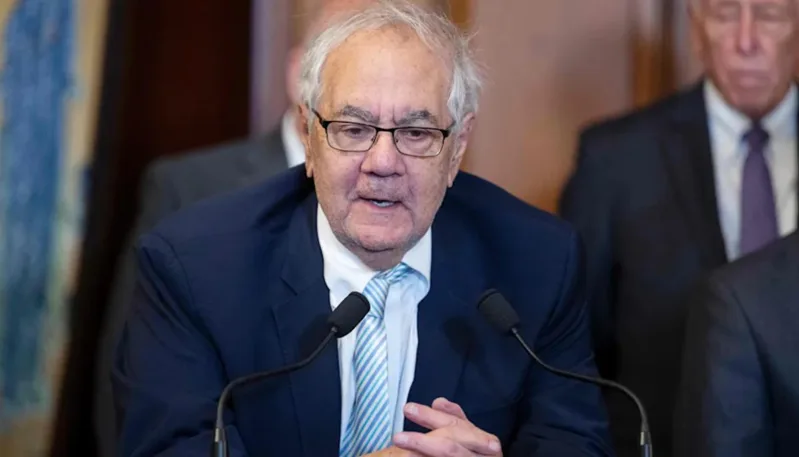
Barney Frank, the sharp-tongued former congressman who became one of the most influential Democratic lawmakers of the modern financial era and a central architect of Wall Street reform after the 2008 economic collapse, has died at the age of 86.
Frank died Tuesday night after a prolonged battle with congestive heart failure, according to reports from people familiar with the matter. He had reportedly entered hospice care earlier this year at his home in Maine after suffering declining health in recent months.
The former Massachusetts Democrat spent more than three decades in Congress and built a reputation as one of Washington’s fiercest political operators — admired by allies for his policy mastery and feared by opponents for his devastating wit during congressional hearings and televised debates.
For many Americans, Frank’s legacy became permanently tied to the aftermath of the 2008 global financial crisis, when the United States faced one of the worst economic meltdowns since the Great Depression. As panic spread across global markets, major financial institutions collapsed, millions lost their jobs and homes, and lawmakers in Washington scrambled to prevent the entire banking system from imploding.
At the center of that effort stood Barney Frank.
As chairman of the powerful House Financial Services Committee, Frank played a leading role in shaping the sweeping financial reform legislation that eventually became known as the Dodd-Frank Wall Street Reform and Consumer Protection Act. The law dramatically expanded federal oversight of banks and financial institutions, imposed tighter regulations on risky trading practices, and created new consumer protections designed to prevent another catastrophic financial collapse.
Supporters viewed the legislation as a necessary crackdown on unchecked corporate greed and reckless banking behavior that had nearly destroyed the global economy. Critics, particularly within conservative and business circles, argued that the reforms gave the federal government excessive power over private markets and burdened financial institutions with costly regulations.
Despite the political warfare surrounding the legislation, the Dodd-Frank Act became one of the defining domestic policy achievements of the Obama era and cemented Frank’s place in modern American political history.
Born in Bayonne, New Jersey, Frank entered politics at a young age and quickly established himself as a highly intelligent and unusually combative political figure. He served in the Massachusetts House of Representatives before winning election to Congress in 1980.
Over the next three decades, he became one of the Democratic Party’s most recognizable voices on issues ranging from banking oversight and housing policy to civil liberties and social justice. Frank was also among the first openly gay members of Congress, becoming a groundbreaking figure during a period when LGBTQ representation in national politics remained extremely rare.
Though deeply respected for his intellect and legislative skill, Frank was equally known for his confrontational political style. He routinely dismantled opponents during congressional hearings with rapid-fire responses, sarcasm and blunt criticism that often generated viral television moments long before social media transformed political culture.
His exchanges with Republican lawmakers during the financial crisis era became particularly famous, as he aggressively defended federal intervention in the banking system while accusing Wall Street executives of endangering the broader economy through unchecked risk-taking.
Even after retiring from Congress in 2013, Frank remained a powerful voice within Democratic politics and continued appearing regularly on television and at policy forums, where he commented on banking regulation, elections and the ideological direction of the Democratic Party.
In one of his final public interviews, Frank reportedly reflected on the physical and emotional toll of public life, joking that decades of political battles had left his “heart wearing out.” Friends and former colleagues said his health had deteriorated significantly over the past year.
Tributes began pouring in almost immediately after news of his death spread.
Democratic lawmakers praised Frank as one of the most consequential legislators of his generation, while financial policy experts credited him with reshaping the relationship between Washington and Wall Street after the 2008 collapse.
Several former congressional colleagues described him as brilliant, relentless and unapologetically authentic — a politician who rarely softened his opinions for political convenience.
While admired by progressives and institutional Democrats alike, Frank also remained a deeply polarizing figure throughout much of his career. Conservatives frequently blamed him for expanding government influence over financial markets and accused him of contributing to policies that intensified the housing crisis, allegations he repeatedly rejected.
Still, even many political opponents acknowledged his extraordinary command of policy details and his unmatched debating ability.
Frank’s death marks the end of an era for a generation of Democrats who dominated Washington during the post-Cold War political landscape and helped shape America’s economic response to one of the gravest financial disasters in modern history.
He is survived by members of his family and close friends.