
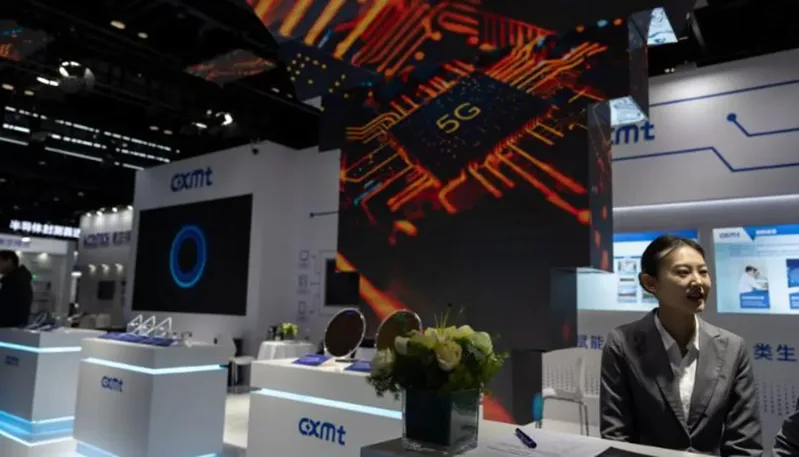
A four-year-old memory chip company most people outside the semiconductor industry had never heard of just became the single most valuable listed company in China — bigger than Industrial and Commercial Bank of China, one of the largest banks on Earth.
CXMT Corp, formally ChangXin Memory Technologies, made its trading debut on Shanghai's tech-focused STAR Market on Monday and didn't so much rise as detonate: shares surged as much as 530% intraday before settling around a 466% gain, closing at roughly 49 yuan against an IPO price of just 8.66 yuan. That pushed CXMT's market capitalisation to about 3.3 trillion yuan — roughly $460 billion — eclipsing ICBC's 2.6 trillion yuan valuation in a single trading session.
The listing itself was already historic before a single share changed hands. CXMT raised 57.92 billion yuan ($8.6 billion), making it the biggest semiconductor IPO in mainland Chinese history — more than seven times the size of chip giant SMIC's landmark 2020 Shanghai listing — and Asia's largest IPO of any kind this year.
Why a Memory Chip Company, and Why Now
To understand why investors piled in so aggressively, you have to understand what CXMT actually makes and where it sits in a much bigger geopolitical story. The Hefei-based firm produces DRAM — dynamic random-access memory chips that sit inside every smartphone, laptop, and data-center server on the planet. It's currently the world's fourth-largest DRAM maker, trailing only Samsung, SK Hynix, and Micron, and held roughly 7.67% of the global DRAM market last year according to its own IPO prospectus.
That matters enormously right now because the global memory chip market is unusually tight. Explosive demand for AI infrastructure — the servers and data centers powering the current AI boom — has been eating into DRAM supply worldwide, and industry analysts expect price increases to continue through the end of 2027. Buyers everywhere are actively looking to diversify away from the traditional Korean and American suppliers, which is exactly the opening CXMT has been built to exploit.
There's also a sharper strategic layer. CXMT has emerged as a central pillar of Beijing's push toward semiconductor self-sufficiency, a campaign that has only intensified as Washington has tightened export controls on advanced chip technology to China. Every dollar of market value CXMT adds is, in effect, a data point in China's argument that it can out-build American restrictions rather than be strangled by them. Adding to the intrigue, reports emerged earlier this month that Apple has begun testing CXMT's memory chips for devices sold within China — a signal that even Western tech giants may have little choice but to route around the chip war rather than sit outside it.
The Global Ripple Effect
For markets and consumers far from Shanghai, this isn't just a China story. A well-capitalised new DRAM supplier entering a supply-constrained global market — at scale, with state backing, and now flush with $8.6 billion in fresh capital — has knock-on effects for everyone who buys phones, laptops, or cloud computing capacity, including in markets like Pakistan where imported electronics pricing is directly exposed to global chip-supply swings. If CXMT's capacity expansion helps ease the current memory crunch even modestly, it could put downward pressure on device prices over the next two to three years. If instead it simply feeds China's AI buildout without meaningfully easing global scarcity, the tight-supply, high-price environment analysts are already forecasting through 2027 could hold or worsen.
Either way, Monday's debut adds a new, heavily capitalised player to a chip war that was already reshaping global supply chains — and puts a very large, very public price tag on how seriously investors are taking China's bet that it can build its way around Washington's restrictions rather than negotiate its way through them.