
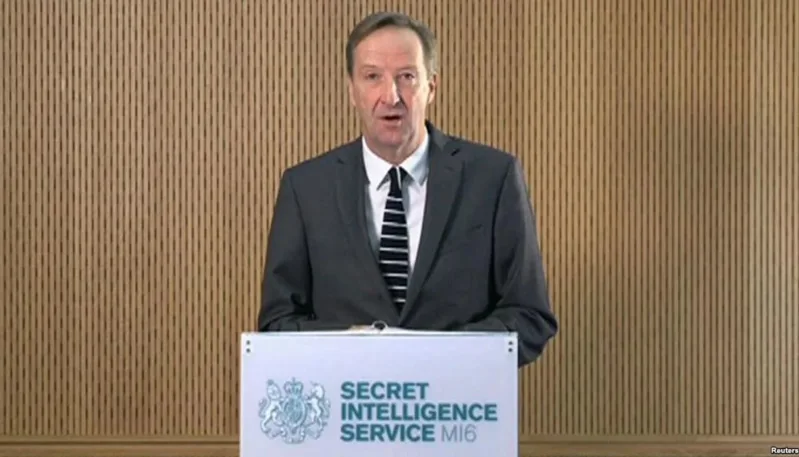
Former British intelligence chief Sir Alex Younger has died at the age of 62 after a battle with cancer, prompting an outpouring of tributes from political leaders, intelligence figures, and colleagues across the national security community.
Sir Alex, who led the Secret Intelligence Service (SIS), commonly known as MI6, from 2014 to 2020, was widely regarded as one of the most influential modern figures in British intelligence. His leadership spanned a period of rapid global transformation in security threats, including the rise of cyber warfare, hybrid conflicts, and state-sponsored digital espionage.
He passed away on Tuesday, with sources confirming he had been suffering from cancer.
A distinguished intelligence career spanning decades
Sir Alex’s career in national service stretched over more than three decades, beginning with his commission into the British Army in 1991. Over the years, he held operational and leadership roles in multiple high-risk regions, including the Middle East, Europe, and Afghanistan, gaining extensive field experience in conflict and intelligence environments.
His transition into the intelligence world saw him rise through the ranks of MI6, where he became known for his operational expertise, analytical discipline, and deep understanding of emerging global threats.
By the time he was appointed chief of MI6 in 2014, he was already considered one of the agency’s most experienced and forward-thinking officers.
Leading MI6 through a new era of espionage
Sir Alex’s tenure at the helm of Britain’s foreign intelligence service came during a period of profound change in the nature of global espionage.
Under his leadership, MI6 underwent a strategic shift away from what he once described as traditional “cloak-and-dagger” intelligence gathering towards a more modern, technology-driven approach—what he referred to as “fourth-generation espionage.”
This new era placed increased emphasis on cyber intelligence, digital surveillance, data analysis, and the integration of advanced technologies into national security operations.
He repeatedly warned that Britain’s adversaries were no longer limited to physical battlefields, but were increasingly operating in cyberspace, using data networks, misinformation campaigns, and digital infrastructure as weapons of influence and disruption.
“James Bond wouldn’t get in”: a stark message on modern intelligence
Sir Alex became a well-known public voice after stepping down in 2020, often offering rare insight into the evolving nature of intelligence work.
In one widely reported address in 2016, he remarked that the fictional spy James Bond would not meet the requirements of today’s MI6 recruitment standards, underscoring just how dramatically the profession had changed.
His comments highlighted the increasing technical, analytical, and linguistic demands placed on modern intelligence officers, as well as the declining relevance of traditional field-spy stereotypes.
Tributes from Downing Street and MI6 leadership
Prime Minister Sir Keir Starmer led the tributes, describing Sir Alex as a “dedicated public servant” whose leadership helped safeguard the United Kingdom during a period of rising global instability.
“Sir Alex led an exemplary life and career,” he said. “He will be remembered for his utmost dedication to British public life and protecting our nation.”
Current MI6 chief Blaise Metreweli also paid tribute, praising Sir Alex as a leader who embodied the core values of the intelligence service.
“He embodied integrity, courage, creativity, and respect,” she said, adding that his contribution to the service had left a lasting institutional legacy.
Knighted for service to the United Kingdom
Sir Alex was knighted in the 2019 Queen’s Birthday Honours, receiving the title Knight Commander of the Order of St Michael and St George (KCMG) in recognition of his distinguished service to British intelligence and national security.
The honour reflected his leadership during a period marked by escalating geopolitical tensions, cyber threats, and the redefinition of intelligence priorities in the 21st century.
A legacy shaped by modern intelligence challenges
Since stepping down from MI6, Sir Alex had become a respected public commentator on global security affairs, frequently contributing analysis on cybersecurity, geopolitical risk, and intelligence reform.
Colleagues described him as a forward-looking strategist who consistently pushed for intelligence services to adapt to technological change rather than resist it.
His legacy is widely seen as one defined by transformation—bridging the gap between traditional espionage methods and the digital intelligence age.
A nation reflects on a security architect
News of his death has prompted reflection within Britain’s defence and intelligence establishment, where Sir Alex is remembered not only as a leader of MI6, but as a key architect of its modern identity.
As tributes continue to pour in, he leaves behind a legacy defined by quiet service, strategic innovation, and a lifelong commitment to national security during one of the most rapidly evolving periods in modern intelligence history.