
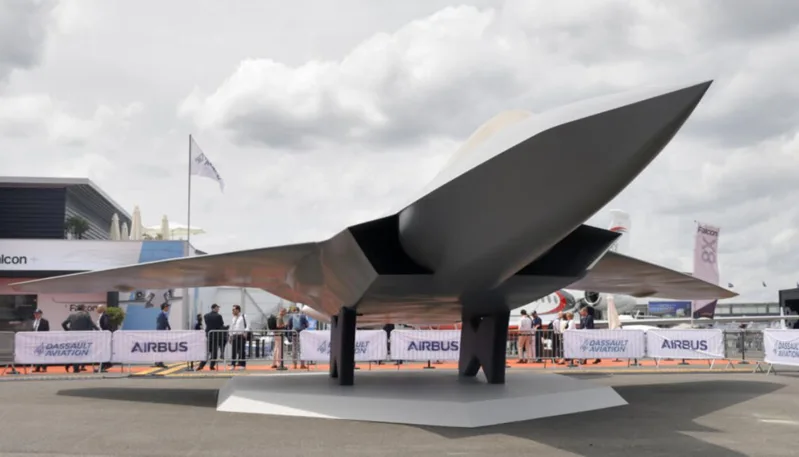
Europe's ambitious plan to develop a next-generation fighter jet has suffered a major setback after Germany and France reportedly agreed to abandon their joint $116 billion project following years of delays and disagreements.
The initiative, launched in 2017 by French President Emmanuel Macron and then-German Chancellor Angela Merkel, was intended to become the cornerstone of Europe's future air combat capabilities. The project, known as the Future Combat Air System (FCAS), also involved Spain and aimed to produce a new-generation fighter aircraft supported by drones and advanced digital warfare systems.
According to Reuters, the fate of the project was discussed by German Chancellor Friedrich Merz and Macron during the recent EU-Western Balkans summit in Montenegro. The two leaders reportedly concluded that the program had little prospect of achieving a breakthrough after years of stalled negotiations.
The development follows months of deadlock between France's Dassault Aviation and European aerospace giant Airbus, which represents German and Spanish interests in the project. The companies struggled to reach agreements on aircraft specifications, industrial responsibilities and control of key technologies.
At the heart of the program was a highly sophisticated "combat cloud" system designed to securely connect fighter jets, drones and military command networks. The technology was envisioned as a crucial step toward strengthening Europe's defense autonomy and reducing reliance on foreign military technologies.
The apparent collapse of one of Europe's largest defense initiatives comes at a particularly sensitive time. European governments are accelerating efforts to strengthen their armed forces amid growing concerns over Russia's military posture and the ongoing war in Ukraine.
Defense analysts argue that the project's failure highlights the challenges Europe faces in turning political ambitions for strategic autonomy into practical military capabilities. While European leaders have repeatedly pledged closer defense cooperation, the FCAS program's troubles expose the difficulties of aligning national interests, industrial priorities and military requirements across multiple countries.
"It’s hardly ideal signalling either to Washington or Moscow," a senior fellow for military aerospace at the International Institute for Strategic Studies (IISS) said, referring to the project's reported demise.
The setback raises fresh questions about Europe's ability to develop major defense platforms independently at a time when the continent is seeking to bolster its military readiness in response to evolving security threats.