
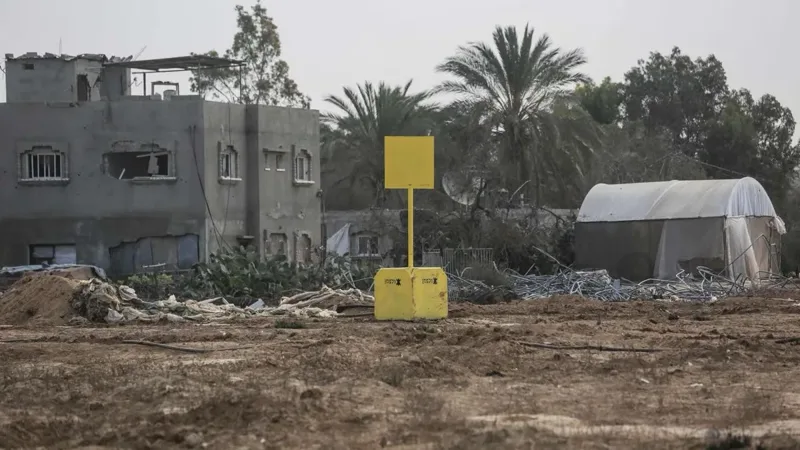
Israel is building a large earthen barrier inside the Gaza Strip, a move that has drawn international attention and raised new questions about the future of the Palestinian territory. Satellite images reviewed by news organisations show that the barrier stretches for more than 23 kilometres (14 miles) through Central and Southern Gaza, separating areas under Israeli military control from the rest of the territory.
The barrier is made of large piles of earth, trenches, and military positions. According to satellite images, construction has continued over recent months in areas where many buildings and neighborhoods were previously destroyed during the conflict. The project follows a line that was originally meant to be a temporary military boundary under a U.S.-backed ceasefire agreement reached in late 2025.
Israeli military officials have confirmed that they are building a physical barrier along what is known as the "yellow line." Israel says the purpose of the barrier is to improve security and prevent attacks from armed groups, including Hamas. Israeli officials argue that stronger defenses are necessary after years of conflict and the October 2023 Hamas attack that led to the current conflict.
However, many Palestinians and international observers fear the barrier could become more than just a temporary security measure. They worry it may eventually create a permanent division inside Gaza, making it harder for displaced Palestinians to return to their homes and changing the territory's borders in practice, even if no official border has been declared.
The Gaza Strip is a small coastal territory that was home to more than two million people before the conflict. Since the destruction of Gaza began, large parts of Gaza have been heavily damaged, and many families have been forced to leave their homes multiple times. Humanitarian organisations continue to warn about shortages of food, clean water, medicine, and shelter for civilians living in the area.
Satellite images show that the barrier runs through farmland, former residential areas, and open land. In some places, military bases have also been established near the barrier. Experts say the construction is one of the biggest physical changes made inside Gaza since the conflict began.
The future of the barrier remains uncertain. Supporters of Israel's actions argue that stronger security infrastructure is needed to stop future attacks and protect Israeli communities near Gaza. They say the barrier is part of broader military efforts aimed at preventing armed groups from rebuilding their positions.
Critics, however, believe the project could make future peace negotiations more difficult. They argue that if the barrier remains in place for a long time, it could make any future agreement on Gaza's governance or borders more complicated. Some human rights organisations have also expressed concern about the effect the barrier could have on the movement of civilians and access to land.
The construction comes while diplomatic efforts to stabilize Gaza continue. Israel recently agreed in principle to allow an international stabilization force into parts of Gaza under a U.S.-backed ceasefire proposal. However, many parts of the agreement are still being negotiated, and attacks from Israel have continued in several areas despite ongoing diplomatic efforts.
At this stage, there has been no official announcement that the earthen barrier will become a permanent border. Israeli officials continue to describe it as a security measure, while many Palestinians fear it could permanently divide the territory. As the conflict continues and negotiations remain difficult, the barrier has become another symbol of the uncertainty surrounding Gaza's future.