
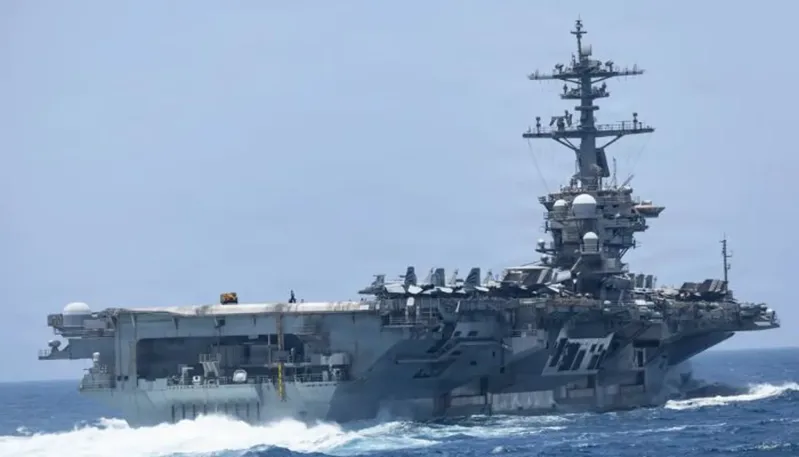
The USS Abraham Lincoln has been deployed for more than 260 days — one of the longest continuous aircraft carrier deployments in modern US Navy history — and the human cost of that extended mission is now spilling into congressional hearings, family protests, and multiple confirmed incidents in which sailors have attempted to go overboard.
What's Confirmed
Stars and Stripes reported that watchstanders aboard the Lincoln stopped a crew member from jumping overboard, an incident serious enough that the ship's command informed the rest of the crew through a shipwide announcement. Separately, Military Times spoke with family members of two sailors involved in related incidents: one sailor is now on medical hold after attempting to jump, his wife saying he fears the episode — which she attributes to prolonged overextension and burnout — could end a 13-year Navy career with a dishonorable discharge. In a second incident, a different sailor physically intervened to pull a shipmate back from the edge before they went over, an act his own wife described him recounting with visible relief days afterward.
The Navy has not disputed that these incidents occurred, though it has pushed back on characterizations of overall conditions aboard the ship. Defense Secretary Pete Hegseth has dismissed some of the reporting on food shortages as "fake news," a characterization families and multiple journalists covering the story have directly contested with photographic evidence.
The Conditions Driving It
According to accounts gathered by Task & Purpose, Forbes, and Military Times from more than a dozen family members — corroborated in part by recordings of meetings between families and Navy leadership — sailors have described moldy showers, broken toilets, inoperative laundry facilities, shortages of basic hygiene supplies like soap and toothpaste, and meals reduced at times to small rationed portions. USA Today separately published photographs in April showing half-empty food trays served aboard the Lincoln and the USS Tripoli, images that prompted several members of Congress to call for a formal investigation even before this month's reports of self-harm incidents.
The deployment itself explains much of the strain. The Lincoln left its San Diego homeport on November 21, 2025, expecting to return by May. Instead, the carrier was rerouted toward the Middle East and has been extended multiple times amid the Trump administration's military campaign against Iran, Operation Epic Fury, which began in late February. The crew has set foot on land only twice since departure — briefly in Guam in December, where many sailors weren't permitted to disembark, and again in Oman in July, where personnel who could leave the ship were restricted to a secured compound rather than given genuine shore leave. Crew members have been working sustained 12-to-16-hour shifts with no announced days off, in a region the US military has formally designated a combat zone.
The Political Response
The situation has drawn a rare moment of bipartisan-adjacent congressional attention, even if the framing differs sharply along party lines. Senator Ruben Gallego, a Democrat and Marine Corps combat veteran, published an unusually pointed public statement describing the reports — moldy showers, sporadic hot water, rationed meals, and threats of sailors going overboard — as a "frightening alarm bell," directly criticizing the administration's handling of what he called an illegal war for how it is treating service members. Senator Richard Blumenthal has separately pressed Defense Department leadership and acting Navy Secretary Hung Cao for answers on plumbing, supply, and mental health conditions aboard the ship. At a meeting in San Diego, roughly 200 relatives of Lincoln crew members confronted Cao directly over both the conditions and the absence of any confirmed return date.
The Navy's position, as relayed through official channels, has generally emphasized crew resilience and disputed the more severe characterizations of shortages, while not directly denying that the overboard incidents took place.
Why the Comparison to the Gerald Ford Matters
This isn't an isolated story about one ship. The USS Gerald R. Ford, deployed separately in the same period, suffered its own crisis in March when a fire broke out in living quarters housing roughly 600 crew members, injuring around 200 personnel and forcing the carrier to divert to Crete before eventually returning to the US. Taken together, the two incidents are becoming a broader case study in the strain an unusually high operational tempo — sustained combat-zone deployments, minimal port calls, and limited carrier availability across the fleet — is placing on Navy personnel and equipment alike. With few carriers available to relieve the Lincoln, some reporting suggests its deployment could extend another one to two months, potentially approaching record territory before it ends.
This is a developing story involving reports of attempted self-harm among service members; accounts of what occurred aboard the ship continue to be updated as more information from the Navy and family members becomes available. If this topic affects you or someone you know personally, the Veterans Crisis Line and Military OneSource both offer confidential support.