
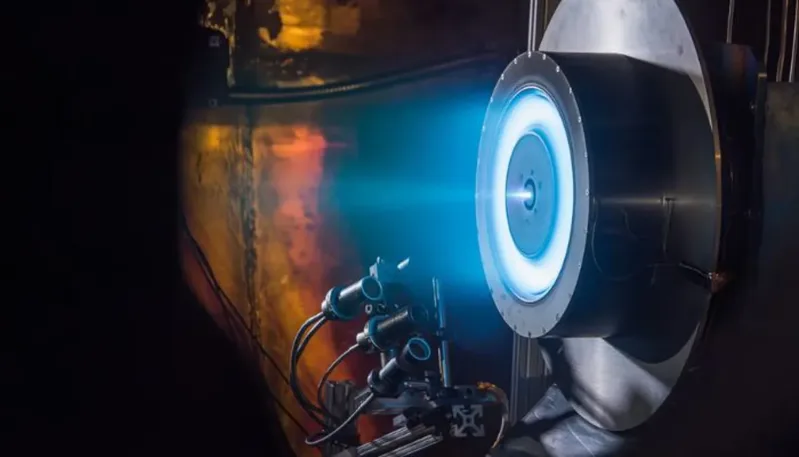
On February 24, inside a specialized vacuum chamber at NASA's Jet Propulsion Laboratory in Southern California, engineers fired up an experimental rocket engine unlike anything currently flying in space: a thruster that runs on vaporized lithium metal, ignited to a power level of 120 kilowatts — more than 25 times more powerful than the electric thrusters currently propelling NASA's Psyche spacecraft, which today holds the record for the most powerful electric propulsion system NASA has ever flown operationally.
It's a genuine milestone, and it's real progress toward a technology that could eventually reshape how humans travel to Mars. It's also, importantly, a long way from being ready to fly — and the gap between "record-breaking lab test" and "engine on a Mars-bound spacecraft" is worth understanding clearly, because it's easy for headlines to blur the two.
What Was Actually Tested
The device is called a lithium-fed magnetoplasmadynamic thruster, or MPD thruster for short — a concept that's existed in propulsion research since the 1960s but has never actually flown on an operational spacecraft. The basic physics: rather than burning chemical fuel like a conventional rocket, the thruster sends a powerful electric current through vaporized lithium metal, turning it into plasma. The interaction between that current and a magnetic field accelerates the plasma out of the engine at high speed, generating thrust.
Electric propulsion of this general family already exists in space — it's what powers Psyche on its current journey toward the asteroid 16 Psyche — but it's historically been low-power and low-thrust, the kind of system that accelerates a spacecraft gradually over months rather than providing the punch needed to move something as heavy as a crewed Mars vehicle. Lithium was chosen specifically because it's light, abundant, easy to store as a solid metal, and — critically for engineering purposes — condenses cleanly on chamber walls during testing rather than contaminating equipment the way some alternative propellants do.
James Polk, the JPL senior research scientist leading the effort, brings a rare pedigree to this specific problem: he worked on Deep Space 1, NASA's 1998 mission that first proved electric propulsion could work beyond Earth orbit, giving him a direct through-line from that original proof-of-concept to this attempt to scale the same underlying idea up to Mars-mission power levels.
The Real Scale of the Challenge Ahead
Here's where the "three months to Mars" framing needs serious qualification. A crewed Mars mission would require somewhere between 2 and 4 megawatts of total propulsion power — meaning a cluster of multiple MPD thrusters working in tandem, not a single engine. February's 120-kilowatt test, while a genuine U.S. record, represents roughly 3-6% of the total power a real mission would need. NASA's own near-term target is to scale individual thrusters up to somewhere between 500 kilowatts and 1 megawatt each — still short of what a full mission demands, and still years of engineering work away.
Durability is the other unresolved problem, and arguably the harder one. The thruster's components operate at temperatures exceeding 2,800°C, and any engine actually used for a Mars mission would need to run continuously for more than 23,000 hours — roughly two and a half years of nonstop operation — without failure. That's an extraordinary durability bar for hardware operating at those temperatures, and it's the specific challenge Polk's team, working alongside collaborators at Princeton University and NASA's Glenn Research Center, expects to spend years methodically testing.
There's also a power-source problem the thruster itself doesn't solve. Reaching megawatt-scale power in deep space, far from the sun where solar panels lose effectiveness, would very likely require pairing these thrusters with a nuclear electric propulsion system — meaning a compact nuclear reactor generating the electricity the thrusters consume. NASA has separate, ongoing space nuclear propulsion research, but an operational nuclear power source of that scale doesn't yet exist either, and it's a parallel, equally difficult engineering effort that has to succeed alongside the thruster work for the "faster Mars trip" vision to actually materialize.
Why the Speed Claim Is Real, Just Not Imminent
None of this means the technology's promise is overstated — the physics genuinely support it. Electric propulsion uses up to 90% less propellant than traditional chemical rockets, because rather than expending massive fuel reserves in a short burn, it applies continuous low thrust over a long period, gradually building enormous velocity. Paired with sufficient nuclear power, that continuous acceleration is what could plausibly cut Mars transit time from the roughly nine months a chemical-rocket trajectory currently requires down to something closer to three — a difference that matters enormously for crew radiation exposure, life-support requirements, and overall mission risk on a future human Mars mission.
The honest summary: February's test is a legitimate, record-setting step on a research path NASA has been walking for decades, not a sign that fast Mars transit is close at hand. Multiple more years of scaling, thermal-durability testing, and a still-unsolved nuclear power question stand between this lab result and an actual mission — but it's exactly the kind of incremental, unglamorous engineering progress that eventually turns into the missions that do fly.