
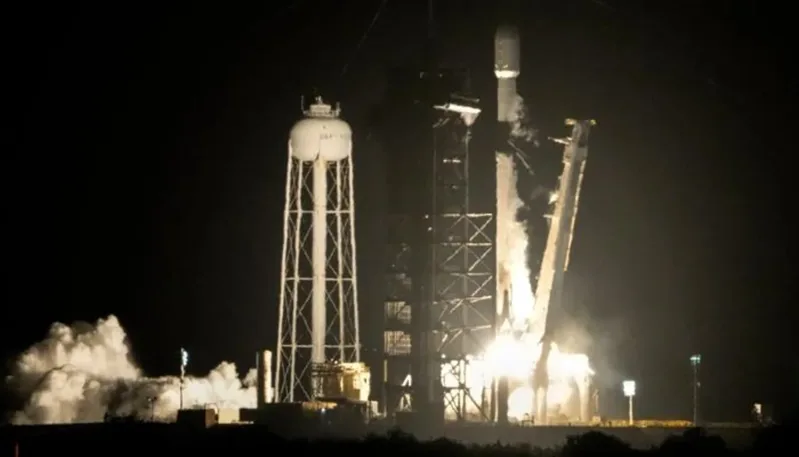
Early Wednesday morning, a four-metric-tonne chunk of a SpaceX Falcon 9 rocket slammed into the Moon at roughly 5,400 miles per hour, striking near the Einstein Crater on the lunar far side with a force scientists estimate at around three tons of TNT. It's the kind of headline that sounds like a disaster movie trailer. It isn't one — but the real story is quieter and more important than the collision itself: nobody planned this, nobody could stop it, and there is currently no functioning global system to prevent the next one.
What Actually Happened
The object that hit the Moon wasn't space debris in the ominous sense most people imagine. It was the spent upper stage of a Falcon 9 rocket, catalogued as 2025-010D, that launched Firefly Aerospace's Blue Ghost Mission 1 back in January 2025 — the mission that went on to make a historic commercial Moon landing that March. Once its job was done, the stage was left drifting in space rather than being deliberately deorbited, and over the following months, the combined pull of solar radiation pressure and lunar gravity gradually bent its path until a collision became mathematically inevitable.
That inevitability, notably, was public knowledge for months. Independent astrodynamicist Bill Gray, who runs the orbit-tracking software Project Pluto, first flagged the coming impact last year and had narrowed the predicted time down to within minutes by the time it actually happened. NASA's own Lunar Reconnaissance Orbiter and South Korea's Danuri spacecraft were both positioned to attempt observation, and a peer-reviewed paper — co-authored by NASA researchers and published ahead of the event — explicitly framed the collision as a rare, welcome opportunity: a chance to test real-time methods for localising lunar impacts, study how debris and dust plumes behave on an airless world, and build better tools for tracking hazards before they become a genuine problem.
NASA Administrator Jared Isaacman's public reaction — dismissing it as "not a big deal" — reflects that scientific framing. In isolation, he's right. A 65-to-90-foot crater on a Moon that's absorbed billions of years of impacts changes essentially nothing.
The Part That Should Actually Concern People
The reason this event is getting attention beyond astronomy circles is what it represents rather than what it did. This is not the first time a rocket stage has hit the Moon by accident — a booster believed at first to be SpaceX hardware crashed near the Moon's far side in 2022, before turning out to belong to a Chinese Chang'e 5T1 mission. And by some recent estimates, discarded human hardware on and around the Moon — spent stages, defunct landers, mission debris going back to the Soviet Union's Luna 2 in 1959 — now totals in the range of 200-plus tonnes.
That number matters because lunar traffic is about to increase sharply, not gradually. NASA's Artemis program is working toward a sustained human presence on the lunar surface. Private companies are already running commercial landing missions on a near-annual cadence. Multiple countries are planning their own lunar landers and eventual bases. Every one of those missions leaves behind hardware, and unlike debris in Earth orbit — most of which eventually burns up harmlessly in the atmosphere — anything left in cislunar space or on the lunar surface simply stays there, because the Moon has no atmosphere to clean up after us.
Compounding the problem: there is no formal, agreed international system for tracking debris once it leaves Earth orbit. What tracking does exist is largely improvised — done by researchers like Gray using software originally built to hunt asteroids, not by any binding treaty obligation or coordinated space agency effort. Existing space law, most of it drafted during the Cold War era around the 1967 Outer Space Treaty, was never designed with a scenario like this in mind: dozens of national space agencies and an even larger number of private companies all operating in the same shared lunar environment, with no enforceable mechanism to require anyone to responsibly dispose of what they leave behind.
Why This Isn't Just an American or Chinese Problem
This matters well beyond the countries currently capable of reaching the Moon. Space law and orbital governance are global-commons issues in the truest sense — decisions being effectively made right now, by precedent rather than treaty, will shape the rules every future spacefaring nation operates under, including countries like Pakistan that are steadily building their own space programs and satellite capabilities. A regulatory vacuum that lets the most active players set norms by default, simply because they got there first and moved fastest, is the same pattern that has played out in Earth-orbit debris policy for decades — and it's a pattern smaller and newer space programs have historically had little say in shaping.
Wednesday's impact caused no harm and generated genuinely useful science. But it also served as a very public, very literal demonstration of a governance gap that isn't going to close on its own — and one that gets more expensive to fix with every rocket stage nobody bothers to bring home.