
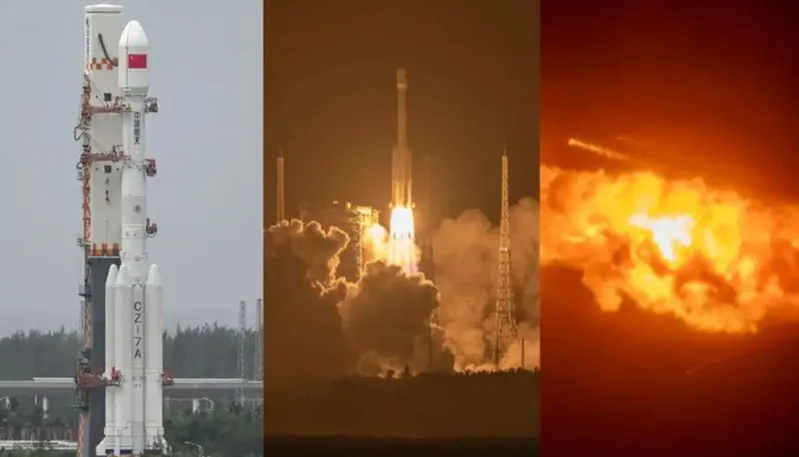
A Long March 7A rocket climbing normally out of the Wenchang Space Launch Site on Hainan island erupted into a fireball roughly 85 seconds after liftoff Monday night, destroying both the vehicle and the satellite it was carrying over the South China Sea. State news agency Xinhua confirmed the failure about three hours later, describing only an "anomaly during flight."
What the Footage Actually Shows
Amateur video captured near the coastal spaceport shows the rocket ascending cleanly for the first 85 seconds — still well inside its main first-stage engine burn, since the Long March 7A's stage separation typically doesn't occur until just under three minutes into flight. Then, without warning, a bright flash gives way to what witnesses described as multiple glowing fragments scattering across the night sky. Space analysts monitoring the launch have suggested a major structural or propulsion anomaly likely triggered the rocket's automatic flight termination system — the safety mechanism designed to deliberately destroy a rocket mid-flight if it's judged to be veering dangerously off course — though Chinese officials had not confirmed a specific cause at time of writing.
The payload, initially reported by state broadcaster China National Radio as Zhongxing-4B (also referred to as ChinaSat-4B), was headed for high Earth orbit. Notably, CNR's own report on the mission's purpose disappeared from its website shortly after the failure, returning a 404 error — and low-numbered Zhongxing satellites are widely understood within the space-tracking community to typically serve military communications purposes, meaning the loss carries a strategic as well as a commercial dimension.
A Rocket With a Rocky History
This isn't the Long March 7A's first stumble. The rocket family debuted in March 2020 — and that inaugural mission also ended in a launch failure, meaning Monday's incident is only the vehicle's second flight ever to fail, but a second failure on a rocket China has increasingly relied upon is still a meaningful reliability blemish. The 7A stands 60 metres tall and is built specifically for geostationary transfer orbit missions, combining stages from the Long March 7 family with a hydrogen-oxygen-powered third stage capable of lifting up to seven tonnes — making it one of China's primary workhorses for exactly the kind of high-orbit communications and military satellite launches Monday's mission represents.
Why the Timing Is the Real Story
Here's the detail that turns a rocket failure into a genuinely consequential setback rather than a routine one: China is currently less than two weeks away from launching Chang'e 7, an ambitious lunar mission that would place the first rover from any nation at the Moon's south pole — a mission of significant scientific and geopolitical prestige, given the intensifying international race to establish a presence in that specific region ahead of future crewed lunar bases. Chang'e 7 is set to fly on a Long March 5 rocket, a different vehicle from the 7A that failed Monday — but both rockets' engines draw on the same core propulsion family, the kerosene-and-liquid-oxygen-fuelled YF-100, which generates roughly 270,000 pounds of thrust at sea level and underpins much of China's modern heavy-lift capability.
That shared engine lineage doesn't mean Chang'e 7 is now in jeopardy — Chinese space officials have given no indication of a mission delay, and different rocket variants using engines from the same family have distinct manufacturing batches, testing histories, and failure modes. But it does mean Monday's failure lands at the worst possible moment for public confidence, just as China prepares to put its most technically ambitious and most closely watched mission of the year on the launch pad, using propulsion technology from the same lineage that just failed publicly and on video.
Keeping the Failure in Perspective
It's worth noting that rocket failures, while dramatic, are not unusual even for mature space programs — SpaceX, NASA's contracted providers, and Russia's Roscosmos have all suffered high-profile launch failures in the past decade, including a 2015 SpaceX Falcon 9 explosion that destroyed a NASA resupply mission to the International Space Station. Spaceflight remains a genuinely difficult engineering problem regardless of which country or company is attempting it, and no space program — American, Chinese, Russian, or private — has a perfect record.
What makes this incident notable isn't that China suffered a launch failure; it's the specific timing, days before Chang'e 7, and the fact that the lost payload appears to have carried a military as well as commercial function — combining a scientific-prestige clock with a national-security dimension in a single, very public failure over the South China Sea.