
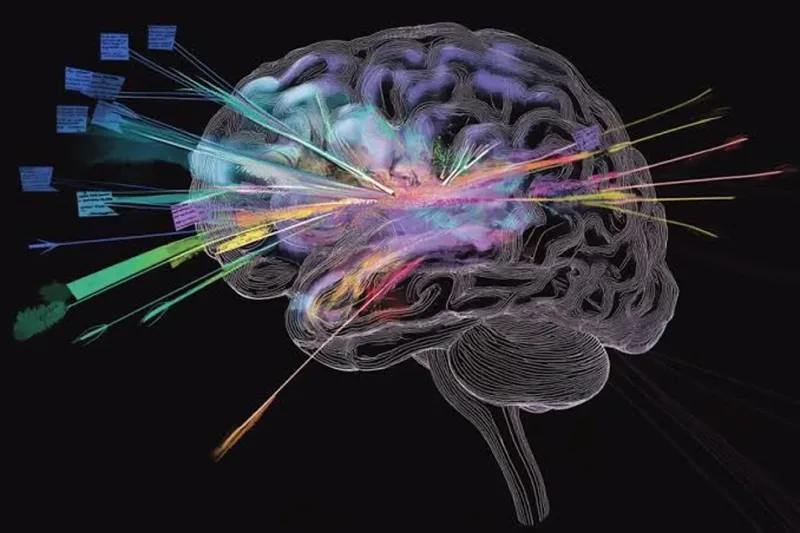
The scientists have achieved a great breakthrough in terms of comprehension of how the human brain perceives speech. It is a recent study that found particular brain cells that interact and allow to perceive grammar, meaning, and the context of speech. Scientists claim that the achievement can help develop better treatments for people with problems with speech and perception caused by strokes, epilepsy or brain injury.
The study was conducted with funding from the National Institutes of Health (NIH). The research performed by the scientists from Massachusetts General Hospital gives one of the most clear pictures ever of how the brain works while processing spoken words and turning them into dialogue.
To conduct the experiment the researchers used eight patients with the electrodes that were inserted in the brain during the treatment of their epilepsy. When they held natural dialogue, the researchers registered the activity of brain cells.
Thanks to AI and machine learning technology, the scientists examined thousands of brain waves. It turned out that different neuron networks became activated depending on the part of the language that the brain processed. Neurons responsible for grammar help to make sense of the sentence's construction; some other neurons were responsible for the meanings of the words used, while yet another group helped people understand the context of a discussion so that they would be able to get the true meaning of the words said.
The results obtained prove that speech is not managed by any one area of the brain but, on the contrary, by many individual neurons that interact in a well-coordinated manner, which enables people to recognize words, comprehend their meanings, find an appropriate response, and utter them within fractions of seconds.
This study represents the first attempt to see language processing on the cellular level of the brain during an actual discussion. The researchers note that previous studies dealt only with larger brain areas.
This finding could have great medical implications as well. The results of the study will probably assist in further development of brain-computer interface. This is the technology that allows transforming brain impulses into speech and writing. People suffering from such diseases as paralysis, stroke or even such diseases as ALS would then be able to communicate.
Furthermore, scientists think that the research results could lead to more efficient treatment of speech and language disorders. Knowing in detail how normal brain cells operate when processing language information could help to develop efficient ways to cure patients having difficulties with communicating.
Even though the sample of participants was rather small, scientists still consider this work as a real breakthrough in neuroscience. They suggest conducting bigger experiments to prove the results and use them later in creating more advanced healthcare technologies.
It is believed that this experiment has got the scientists closer to uncovering the secrets of our brain. The brain of human is a very complex thing; and the way how it allows us to communicate seems amazing. One day the scientists might create the technology that will help paralyzed or mute people to speak again.