
World
Ted Turner, CNN Founder Who Revolutionized Global News, Dies at 87
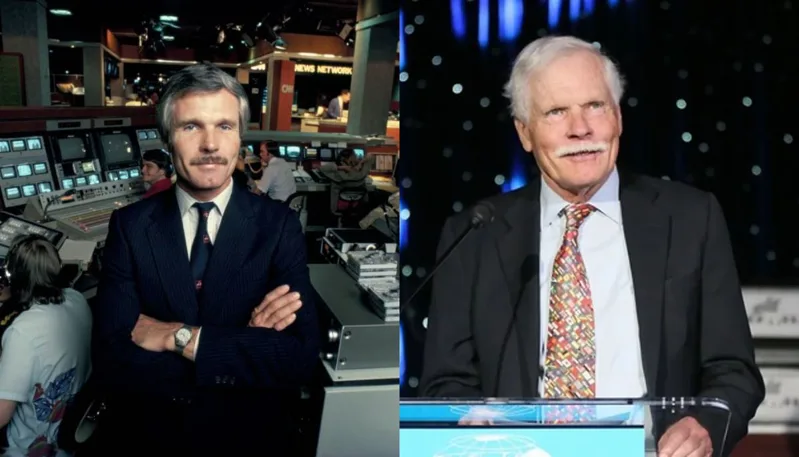
The media mogul spent his final years battling Lewy body dementia before passing away peacefully Wednesday
Ted Turner is dead. The founder of CNN and one of the most important figures in the history of modern media passed away Wednesday at 87. He died peacefully, surrounded by family, according to Turner Enterprises. He had been in hospice care.
No cause of death was given. Turner had been living with Lewy body dementia since 2018, a condition he announced publicly himself, just before turning 80.
A Difficult Beginning
He was born Robert Edward Turner III on November 19, 1938, in Cincinnati, Ohio. His childhood was not easy.
His father was a volatile man who disciplined his son with a leather strap. He later shot himself in 1963, leaving a 24-year-old Ted in charge of the family billboard company. His younger sister Mary Jean died after five years of suffering from a rare form of lupus.
"She hadn't done anything wrong," Turner once said. "What had she done wrong?"
He dropped out of Brown University after his father cut off his tuition. He went back to Georgia. He got to work. That became the story of his life.
Building a Media Empire
Turner bought a struggling Atlanta TV station in 1970. In 1976, he put its signal on a satellite and created cable TV's first superstation. Then he bought the Atlanta Braves. Then the Atlanta Hawks.
He still was not satisfied.
On June 1, 1980, he launched CNN from a converted country club in Atlanta. The world's first 24-hour all-news television network. The industry laughed. Critics called it "Chicken Noodle News."
"If Alexander the Great could conquer the known world, why couldn't I start CNN?" he once told Oprah Winfrey.
Nobody was laughing by 1991. When the Persian Gulf War broke out, CNN was the only network broadcasting live from Baghdad. The world watched through CNN. Time magazine named Turner its Man of the Year that same year.
He kept building. TNT. Turner Classic Movies. The Cartoon Network. CNN International. The Goodwill Games. A library of more than 4,000 MGM films. He created Captain Planet to teach kids about the environment. He never stopped.
His one rule for CNN, told to former network president Tom Johnson: "Be fair. That's it."
Fortune, Loss, and Jane Fonda
Turner sold everything to Time Warner in 1996 for nearly $7.5 billion. Then came the AOL-Time Warner merger in 2001. One of the worst corporate deals in history. It wiped out billions. He lost CNN. He lost the Braves. He lost the Hawks.
His marriage to actress Jane Fonda ended the same year.
"I lost Jane. I lost my job. I lost my fortune, most of it," he told CNN's Piers Morgan in 2012. "Got a billion or two left. You can get by on that if you economize."
They stayed friends anyway. Fonda called him her "favorite ex-husband" until the end.
He resigned from AOL Time Warner in 2003. He never went back to media.
Philanthropy and Conservation
He did not slow down. He just changed direction.
In 1997, Turner pledged $1 billion to the United Nations. One of the largest private donations in American history. He co-founded the Nuclear Threat Initiative to push for global disarmament. He became one of the largest private landowners in North America, with nearly 2 million acres across 28 properties.
He raised the world's largest private bison herd, around 45,000 to 51,000 animals. He opened Ted's Montana Grill in 2002 to make bison mainstream. He founded the Captain Planet Foundation. He kept giving, kept building, kept moving.
Final Years
In his later years, Turner pulled back. He spent most of his time at his Montana ranches, fishing, riding horses, staying quiet.
He told the world about his Lewy body dementia in 2018. In early 2025, he was hospitalised briefly with pneumonia before recovering.
Then he was gone.
CNN Chairman and CEO Mark Thompson said he was "the giant on whose shoulders we stand."
"He was and always will be the presiding spirit of CNN," Thompson said.
Turner called CNN the "greatest achievement" of his life.
He is survived by five children, Laura, Teddy, Rhett, Jennie and Beau, 14 grandchildren, and two great-grandchildren. Jane Fonda survives him too.
Tags: Cartoon Network, CNN, Ted Turner