
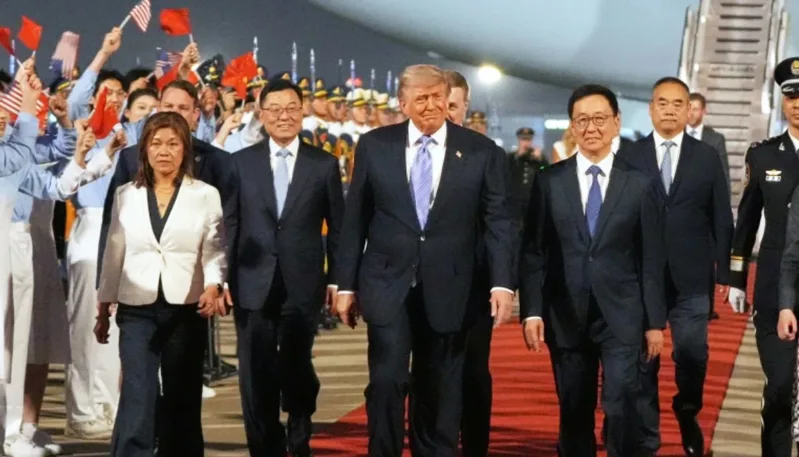
U.S. President Donald Trump arrived in China on an official diplomatic visit and received a red-carpet welcome ahead of expected high-level talks between Washington and Beijing.
The visit comes at a time of growing tensions and competition between the world’s two largest economies over trade, artificial intelligence (AI), semiconductors, cybersecurity, Taiwan, and military influence in the Pacific region.
Trump was accompanied by several major American technology and business leaders, highlighting the economic importance of the trip. Among the executives traveling with the president are xAI CEO Elon Musk, Nvidia CEO Jensen Huang, and Apple CEO Tim Cook.
Other business leaders expected to participate during the Beijing visit include BlackRock CEO Larry Fink, Blackstone CEO Stephen Schwarzman, Citi CEO Jane Fraser, Goldman Sachs CEO David Solomon, Qualcomm CEO Cristiano Amon, Visa CEO Ryan McInerney, and Micron CEO Sanjay Mehrotra.
Why did Trump bring tech executives to China?
Analysts believe Trump’s decision to bring leading technology executives signals that economic and technological issues will dominate discussions with Chinese President Xi Jinping.
The visit is expected to focus heavily on AI development, semiconductor exports, electric vehicles, cybersecurity, and global supply chains.
Many American companies remain deeply connected to the Chinese market despite rising tensions between the two countries.
Apple continues to rely heavily on Chinese manufacturing, while Tesla operates one of its largest factories in Shanghai. China also remains a major market for semiconductor companies such as Nvidia and Qualcomm.
The presence of Nvidia CEO Jensen Huang has drawn particular attention as Nvidia’s advanced AI chips have become central to the growing technology rivalry between the United States and China.
The U.S. government has previously imposed restrictions on the export of advanced AI chips to China over national security concerns. However, several American technology firms have continued pushing for broader access to the Chinese market.
The Trump administration hopes the visit could lead to new commercial agreements, improved market access for U.S. companies, and reduced restrictions on American firms operating in China.
Business leaders accompanying the president may also help advance corporate negotiations and strengthen economic cooperation between the two countries.