
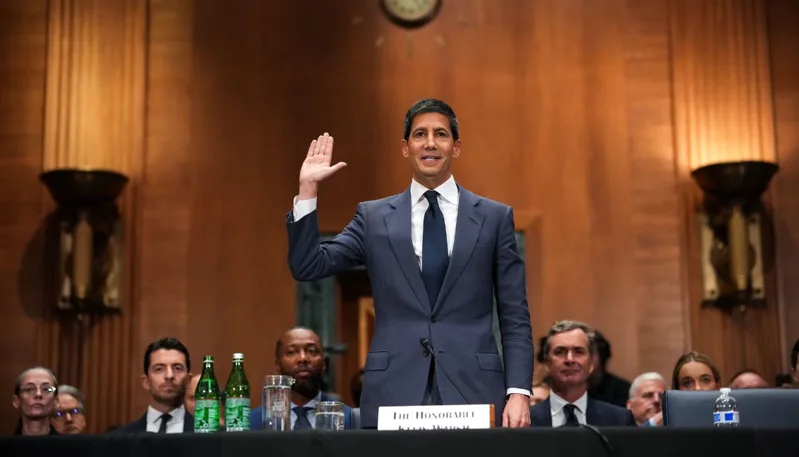
Donald Trump’s nominee to lead the Federal Reserve, Kevin Warsh, has been confirmed by the U.S. Senate, positioning the former central bank official to take charge at a critical moment for the American economy.
Warsh secured Senate approval in a narrow 54-45 vote on May 13 and is expected to officially assume office on May 15, replacing outgoing Federal Reserve Chair Jerome Powell.
The confirmation marks one of the tightest Senate approval margins for a Fed chair in decades, highlighting growing political divisions over the direction of U.S. monetary policy, inflation management, and interest rates.
Kevin Warsh Takes Over During Global Economic Pressure
Warsh will inherit leadership of the Federal Reserve during a period of elevated economic uncertainty and geopolitical instability. Global markets continue to face pressure from persistent inflation concerns, supply chain disruptions, and rising tensions in the Middle East involving the United States, Israel, and Iran.
The incoming Fed chair is also expected to navigate a politically sensitive relationship with President Trump, who repeatedly criticized Powell over interest rate decisions and publicly demanded more aggressive rate cuts during his presidency.
Economic analysts believe Warsh could face a difficult balancing act between controlling inflation and responding to political pressure for lower borrowing costs.
Current U.S. interest rates remain within the 3.50% to 3.75% range, though economists remain divided over whether future rate hikes or cuts will be necessary in the coming months.
Warsh Promises Independence From Political Influence
During his Senate confirmation hearing, Warsh attempted to reassure lawmakers about the independence of the central bank, saying he would not serve as a “sock puppet” for President Trump or any administration.
The comments came amid broader concerns from lawmakers and financial markets about preserving the Federal Reserve’s autonomy in setting monetary policy decisions free from political interference.
Warsh’s leadership style and future policy direction are expected to be closely watched by investors, Wall Street firms, and global markets.
Jerome Powell to Remain on Federal Reserve Board
Although Powell’s term as chair is ending, he previously indicated that he intends to remain on the Federal Reserve’s Board of Governors for the time being.
Speaking during an April 29 press conference, Powell said he planned to keep a low public profile while allowing Warsh to transition into the role.
“I will leave when I think it’s appropriate to do so,” Powell told reporters.
If Powell remains on the board after his chairmanship concludes, it would mark the first time since 1948 that a former Fed chair continued serving as a governor following the end of their leadership term.
Who Is Kevin Warsh?
Warsh, 56, is an American financier and former investment banker who served as a governor of the Federal Reserve between 2006 and 2011 during President George W. Bush’s administration.
Over the years, he has developed a reputation as a market-focused policymaker with deep ties to Wall Street and corporate finance.
Before returning to the spotlight as Trump’s Fed nominee, Warsh remained active in the financial sector and economic policy discussions, frequently commenting on inflation, central bank credibility, and global market risks.
Why the Federal Reserve Chair Matters
The Federal Reserve chair is considered one of the most powerful economic policymakers in the world because the position directly influences U.S. interest rates, inflation control, employment conditions, and financial market stability.
Decisions made by the Fed can impact everything from mortgage rates and business borrowing costs to stock market performance and global investment flows.
Warsh’s appointment is therefore expected to shape the direction of the U.S. economy at a time when inflation, geopolitical tensions, and recession concerns continue to dominate financial discussions worldwide.