
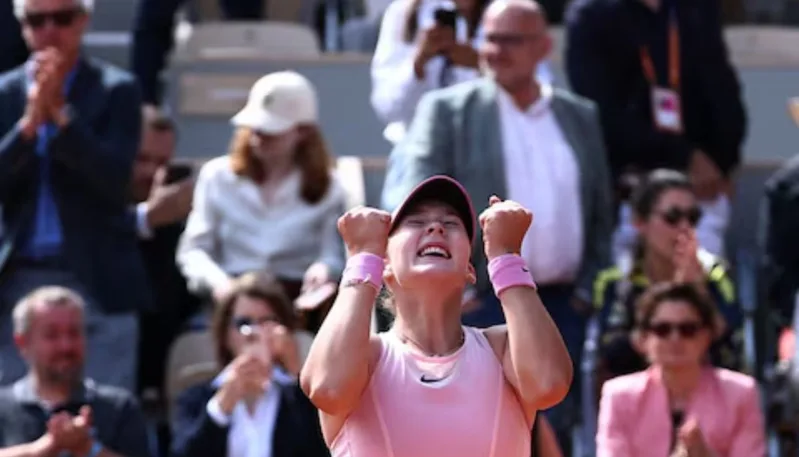
At just 19 years old, Mirra Andreeva has officially arrived on tennis’s biggest stage.
The Russian teenager claimed her first Grand Slam title at the 2026 French Open in Paris, defeating Poland’s qualifier Maja Chwalińska 6-3, 6-2 in a composed and commanding final on Court Philippe-Chatrier. The victory marks her transformation from rising prodigy to Grand Slam champion in front of a global audience.
From teenage prodigy to Grand Slam champion
Andreeva has been on the tennis radar since her early teens, but her breakthrough at Roland Garros confirms what many in the sport had long predicted.
She first made headlines as one of the youngest players to break into elite WTA events, quickly gaining attention for her maturity, shot-making ability, and calm presence under pressure.
Now, in Paris, she has delivered the defining result of her young career—winning a major title before turning 20 and becoming one of the youngest French Open champions in decades.
The final: control, composure, and dominance
The final was not a tense thriller—it was a statement.
Andreeva dictated the match from the baseline, using her aggressive returns and consistent depth to prevent Chwalińska from settling into rhythm. Despite the Pole’s remarkable run through the qualifiers, she struggled to handle the pace and precision of the Russian teenager.
Andreeva closed out the match in straight sets, showing a level of composure rarely seen at this stage of a Grand Slam.
A breakthrough built over years
This title is not a sudden rise—it is the result of steady progression.
Andreeva has already been regarded as one of the most promising players of her generation, having reached major second-week appearances and pushing top-ranked opponents in previous seasons. Her game has matured quickly, combining power with improved tactical discipline and mental control.
Her French Open victory is the first time she has converted that promise into a Grand Slam trophy.
A milestone for Russian tennis
With this win, Andreeva also becomes the first Russian woman in years to win a Grand Slam singles title, adding her name to a lineage that includes major champions of the modern era.
It also reinforces Russia’s continued presence in women’s tennis, even as athletes compete under neutral status in some international events.
Why this win matters beyond Paris
Andreeva’s victory is significant for more than just the trophy.
It signals:
- The rise of a new generation in women’s tennis
- A shift away from long-established dominance at the top
- The emergence of a player capable of challenging for multiple majors
At 19, she is no longer just a prospect—she is now part of the sport’s elite conversation.
Chwalińska’s inspiring run from the qualifiers to the final also added a fairy-tale element to the tournament, but the final underlined the gap between breakthrough stories and established Grand Slam-level execution.
For Andreeva, however, this is likely just the beginning. A first major title often changes expectations—and the tennis world will now watch closely to see how quickly she adds a second.
Mirra Andreeva is no longer just “the next big thing” in tennis.
She is now a Grand Slam champion—young, fearless, and already reshaping expectations for the future of women’s tennis.