
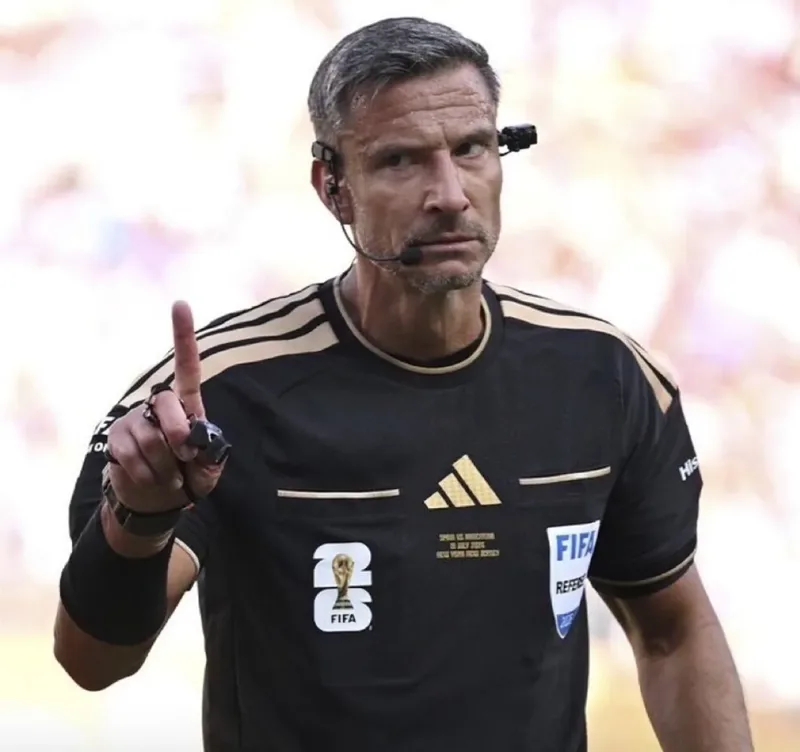
Most referees end their careers quietly, officiating a mid-table fixture nobody remembers before hanging up the whistle for good. Slavko Vinčić chose the opposite path: he went out on the World Cup final itself.
The Slovenian Football Association confirmed this week that the 46-year-old has retired from officiating, one week after taking charge of the 2026 FIFA World Cup final between Spain and Argentina at MetLife Stadium in New Jersey — a match Spain won 1-0 after extra time to claim their second World Cup title. In its statement, the federation called him the first Slovenian head referee ever to take charge of a World Cup final, describing his career as one of the greatest in the sport's officiating history.
It's hard to argue with the résumé. Vinčić began refereeing in Slovenia's top flight in 2007, became a FIFA-listed international referee in 2010, and spent the next 16 years climbing to the very top of a profession most fans only notice when something goes wrong. Along the way he took charge of the 2022 UEFA Europa League final between Eintracht Frankfurt and Rangers, the 2024 UEFA Champions League final between Real Madrid and Borussia Dortmund at Wembley, and matches across four European Championships, in addition to officiating at both the 2022 and 2026 World Cups. His World Cup final appointment brought his tournament tally to six matches across two editions.
Going Out at the Center of the Storm — Not Just the Spotlight
What makes the timing notable isn't just that Vinčić refereed the final — it's what happened inside it. The 2026 final was a tense, physical contest, with Argentina, down to ten men after Vinčić sent off Enzo Fernández late in regulation for a second-yellow challenge on Spain's Pau Cubarsí, before Ferran Torres settled the match in extra time. A red card in the closing stages of a World Cup final is about as high-pressure a call as refereeing offers — the kind of decision that gets replayed, debated, and second-guessed by hundreds of millions of viewers within minutes. Vinčić made it, the match moved on, and Spain lifted the trophy.
That single moment says something about why FIFA trusted him with the job in the first place, and it's the real story behind the retirement headline: officiating isn't remembered for the games that pass quietly, but for whether a referee holds up under the one decision that could unravel the biggest match on the calendar. Vinčić's career closes on exactly that kind of moment, which is part of why the International Federation of Football History and Statistics named him the World Cup's best referee for this edition, and why he received Italy's Giulio Campanati Award in recognition of his officiating.
A Rare Kind of Ending in Football
Players get retirement tours. Referees almost never do — most simply stop appearing on FIFA's list, and fans only notice months later. Vinčić's exit breaks that mold entirely: a deliberate, announced retirement timed to the single biggest match a referee can be given, at the peak of individual recognition rather than in decline. For a profession defined by invisibility — the accepted standard is that a good referee is one nobody talks about afterward — choosing to become impossible to ignore on the way out is itself a statement about how Vinčić wanted his 16-year career to be remembered.