
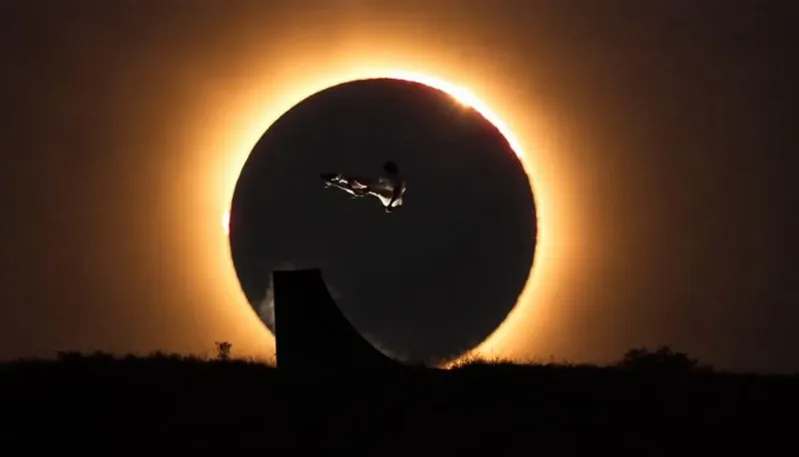
For a fraction of a second on Wednesday evening, the Moon slid directly between the Earth and the Sun over rural Spain, and Danny León launched off a ramp directly into the frame. The result — a silhouetted mid-air trick set against a fully eclipsed sun — is the kind of shot that looks digitally composited even when it isn't. It wasn't. It just happened to look that perfect.
One Shot, No Second Takes
León, a two-time Olympic skateboarder who competed at Tokyo 2020 and Paris 2024, had exactly one opportunity to get this right, and he built his entire stunt around that constraint. Totality — the brief window when the Moon fully blocks the Sun's visible light — lasted only a couple of minutes as it swept across the Spanish peninsula from Galicia to the Balearic Islands, with prime viewing in spots like Teruel and Zaragoza. Planning the shot meant calculating precisely where the eclipse would be positioned in the sky at the exact second of totality, placing a ramp and camera crew in that exact location days in advance, and executing a technical skateboarding trick with zero margin for a second attempt if the timing, the light, or the landing went even slightly wrong.
It didn't. León posted the footage — slow-motion, scored to Michael Jackson's "Earth Song" — with the caption "THE TRICK OF MY LIFE: ECLIPSE MODE," and it did what perfectly executed spectacle reliably does online: it exploded. Different platforms and outlets have clocked wildly varying view counts as the clip spread — from roughly 7 million to over 70 million depending on where and when it's measured — but the trajectory is the same everywhere: a genuine viral phenomenon within hours, crossing over from skateboarding and Olympic fan circles into general astronomy and viral-video audiences worldwide.
The Twist: Proving a Real Moment Actually Happened
Here's the detail that makes this a distinctly 2026 story rather than a straightforward viral clip: the footage looked so implausibly well-composed that a meaningful number of viewers assumed it had to be AI-generated, and skepticism started circulating alongside the praise almost immediately. That reaction says less about León's video specifically and more about where the internet's default trust level currently sits — synthetic video has become common enough, and good enough, that a genuinely real moment executed with elite precision now needs to actively defend its own authenticity. Viral posts sharing the clip were quickly appended with direct links back to León's original Instagram upload, using his own verified account as the proof that no synthetic media was involved.
It's a small but telling example of a phenomenon researchers call the "liar's dividend" — the way the mere existence of convincing fake video makes audiences reflexively doubt real footage too, forcing genuine content to carry an extra burden of proof it never used to need. Ordinarily that dynamic shows up in disturbing contexts, like real war footage being dismissed as fabricated. That the same skepticism now attaches itself to a skateboarder's Instagram trick shot is, in its own way, a marker of how far that trust erosion has spread.
The Bigger Astronomical Backdrop
León's stunt landed inside a genuinely historic astronomical event in its own right: Wednesday's eclipse was Spain's first total solar eclipse in more than a century, drawing an estimated half a million additional visitors into the country and generating hundreds of millions of dollars in eclipse-driven tourism revenue by some estimates. Crowds gathered on hilltops and coastlines nationwide with eclipse glasses and lawn chairs to watch daylight fade into a brief, eerie twilight before the Sun re-emerged — a natural spectacle rare enough on its own that it would have dominated Spanish headlines with or without a skateboarder timing a trick to it.
It's also not the first time León has built a shot around a celestial backdrop; he'd previously photographed himself airborne against a setting sun and, separately, a full moon, joking in the latter post that NASA had left him behind on a mission. Wednesday's eclipse trick, though, is by a wide margin the biggest moment his celestial-photography habit has produced — proof, this time verified, that patience, planning, and a narrow window of cosmic alignment can still outperform anything a computer might generate.