
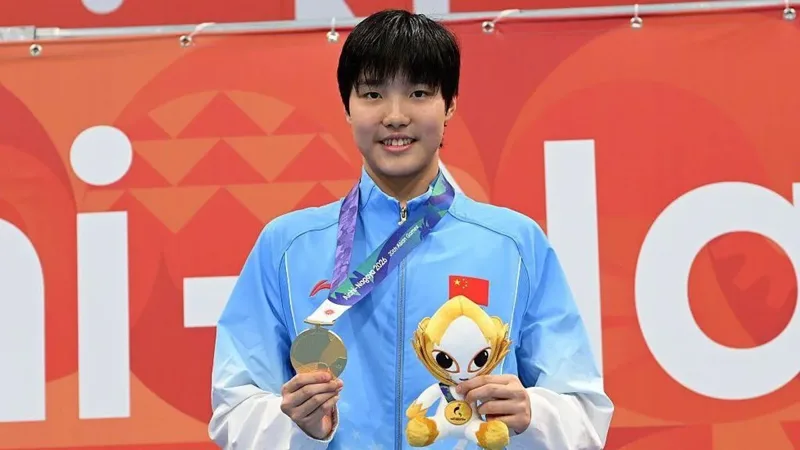
China’s Yu Zidi won the women’s 200-metre individual medley at the Asian Games on September 21 in 2 minutes 6.10 seconds, finishing just four-tenths of a second outside Summer McIntosh’s world record. The 13-year-old’s second gold of the meet has turned a regional title into a performance with significance across international swimming.
Reuters reported that the swim broke the Asian record. It followed Yu’s victory in the 200m butterfly a day earlier, giving the teenager wins in two demanding events rather than a single breakthrough race. McIntosh’s world mark remains intact: going close to a record is not the same as breaking it.
How close was the time?
The comparison is precise. Yu’s 2:06.10 is 126.10 seconds; McIntosh’s 2:05.70 is 125.70 seconds. The difference is 0.40 seconds across the full race, roughly three-tenths of one percent of the world-record time. That arithmetic explains why the performance is attracting attention beyond the medal table.
Swimming World’s analysis places Yu second on the event’s all-time list, ahead of Katinka Hosszu’s 2:06.12 from the 2015 World Championships. Passing that historic mark by two-hundredths is a separate achievement from approaching McIntosh: it locates Yu’s swim among performances that have defined the event.
However, times recorded at different competitions are comparisons on the clock, not the result of a head-to-head race. They do not tell us how two swimmers would respond to each other through heats, recovery periods and a final at the same meet.
Why the individual medley is such a revealing event
As Swim England explains, individual medley brings together butterfly, backstroke, breaststroke and freestyle in that order. In a 200m race, each stroke accounts for 50 metres. A swimmer has to change technique repeatedly while maintaining speed and managing fatigue.
The final freestyle leg cannot simply repeat one of the earlier three strokes. The combination rewards more than being exceptionally fast at a single discipline: the transition between strengths and weaknesses becomes part of the contest. A lead can change character when the race moves from one stroke to the next.
That makes the split times useful when studying a medley performance. The overall result tells us how fast the complete race was; the individual sections show where time was gained or lost. Without those details, it would be speculative to attribute Yu’s improvement to one particular stroke or technical change.
Pool length is another essential part of a comparison. Swim England distinguishes 25m short-course pools from 50m long-course pools. Over the same 200m distance, the shorter pool requires more turns. Readers comparing results should check the course as well as the stroke and distance, rather than combine all 200m times into one ranking.
The progress behind the teenage headline
Yu was already competing close to the top of the sport before this week. World Aquatics’ report from the final night of the 2025 championships in Singapore records her third fourth-place finish of that meet, matching her results in the 200m individual medley and 200m butterfly.
Those results provide a more useful starting point than presenting her as an athlete who appeared without warning. They show she was already reaching major finals across several events. Monday’s performance adds a leading time and a gold medal to that competitive background.
AFP reported that Yu won Sunday’s 200m butterfly in a Games-record 2:05.85. Hong Kong’s multiple Olympic medallist Siobhan Haughey welcomed the emergence of young swimmers, placing Yu’s rise within a sport that has repeatedly seen teenagers reach elite competition.
What comes next
The Associated Press’s coverage, carried by NDTV, points to a possible meeting with McIntosh at the 2027 world championships in Budapest, before the Los Angeles Olympics in 2028. These are potential future contests, not confirmed matchups or a guarantee of Olympic selection.
For followers of the sport, consistency will be as interesting as another headline time: how Yu performs across rounds, different events and future championships. At 13, her career also remains a developing one, and projections should leave room for the athlete rather than turn every competition into a referendum on a future Olympic medal.
Monday’s result already stands on its own. Yu won a second Asian Games title, moved into historically rare territory in the 200m medley and brought McIntosh’s benchmark within four-tenths of a second. The next race will add evidence; it does not need to fulfil a prediction.