
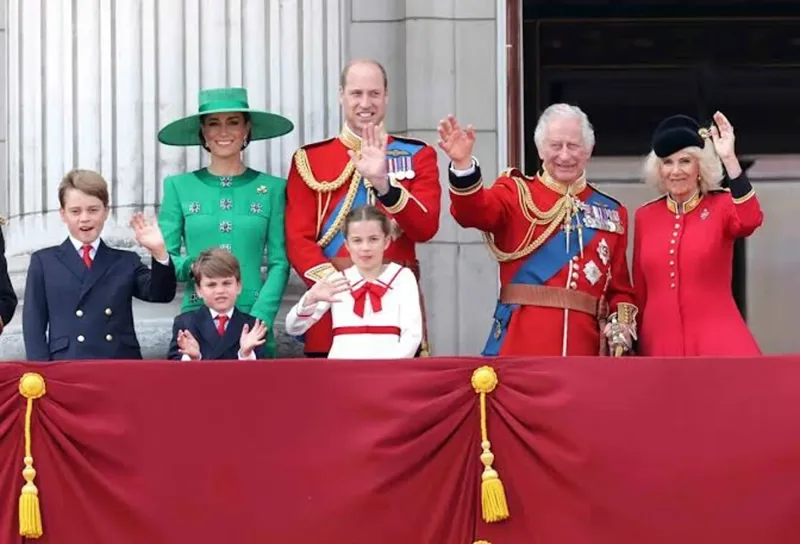
Most explanations of the British line of succession stop at a list: William, then George, then Charlotte, then Louis, then Harry's children, and so on down through the descendants of Queen Elizabeth II. That list is accurate as far as it goes. What it usually leaves out is why the list is shaped the way it is, and why it isn't actually fixed — it's a legal construct that Parliament can and has changed, and that is being tested again in 2026 by the question of what to do about Andrew Mountbatten-Windsor.
The current order
As it stands, the line runs: Prince William, then his three children — George, Charlotte and Louis, in that order — followed by Prince Harry and his two children, Archie and Lilibet. After the Sussex line comes Andrew Mountbatten-Windsor, still eighth in line despite having been stripped of his prince title, followed by his daughters Beatrice and Eugenie and their own children.
That an eighth-in-line former prince who has been formally cast out of royal duties remains on the list at all is not an oversight. It's a direct consequence of how narrow the legal grounds for removing someone from succession actually are.
The rules that decide the order
Three things determine where someone sits in the line.
Descent from Sophia, Electress of Hanover. This sounds archaic because it is — the legal basis for succession still traces back to the Act of Settlement 1701, which restricted the throne to Protestant descendants of Sophia of Hanover. Every person currently in line qualifies through that same 300-year-old chain.
Birth order among siblings, not gender. This is the part that actually changed recently. Until 2015, a younger son could leapfrog an older daughter. The Succession to the Crown Act 2013 ended that: since it came into force, birth order alone determines precedence among siblings, which is why Princess Charlotte stays ahead of her younger brother Louis regardless of the fact that he's a boy.
Not having married a Roman Catholic. The same 2013 Act removed the old rule that marrying a Catholic disqualified someone from the succession outright, though the monarch is still constitutionally required to be in communion with the Church of England.
Beyond those three tests, the order is otherwise just genealogy: legitimate descendants of the sovereign, arranged by generation and birth order.
Why “just remove him” is harder than it sounds
Since Andrew Mountbatten-Windsor's arrest in February 2026 on suspicion of misconduct in public office, there's been open discussion in Westminster — and from Commonwealth leaders including Canadian Prime Minister Mark Carney — about legislating him out of the succession entirely. King Charles has already stripped him of his prince title and military honours, which was within the Palace's own authority to do. Removing him from the line of succession is a different matter, and not one the Palace or even the UK Parliament can do alone.
Because the monarch is head of state in fifteen other Commonwealth realms — Canada, Australia, Jamaica and others — any change to who can inherit the Crown has to be made consistently across all of them, under the convention established when the Statute of Westminster 1931 recognised their equal status. The last time this happened, with the Succession to the Crown Act 2013, agreement in principle at a Commonwealth summit was reached in 2011, but it took until 2015 for every realm to pass or adapt its own legislation and bring the changes into force — the better part of four years, for what was a comparatively uncontroversial, unanimously agreed reform.
A change specifically targeting one individual would be a different kind of process, and there's no guarantee it moves faster. It's the reason legal commentators have been cautious about predicting a timeline, even as political pressure to act has grown.
The part that rarely gets reported
What tends to get lost in coverage of “will Andrew be removed” stories is that being stripped of a title and being removed from the succession are legally unrelated events. Losing “prince” and “Duke of York” changes what he's called and what he's entitled to do publicly. It has no effect on his position in the succession, which is why he's still counted, uncomfortably, at number eight. Only an Act of Parliament — coordinated across the realms — can change that number.
It's a distinction worth understanding on its own terms, because it will almost certainly come up again. The gap between what the Palace can do unilaterally and what requires Parliament, and beyond that what requires agreement across fifteen other governments, is the actual shape of how the modern monarchy is constrained — far more than any single family drama.