
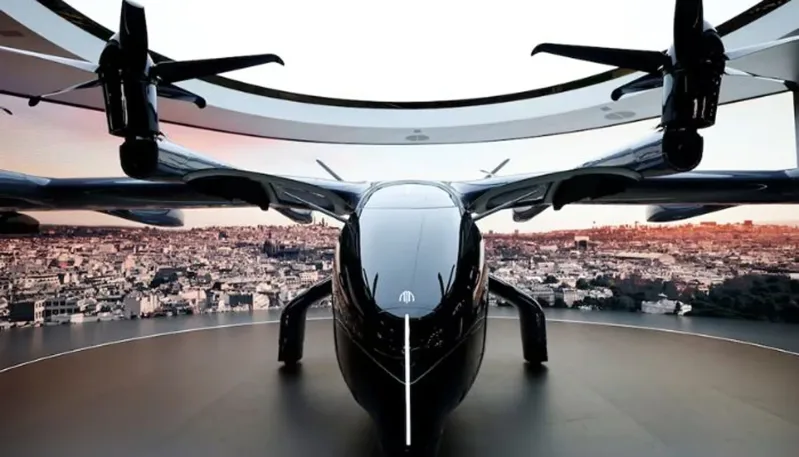
The US Federal Aviation Administration used the Farnborough Airshow this week to lay out one of the more consequential shifts in American aviation policy in decades: a coordinated push to fast-track electric air taxis, revive commercial supersonic flight, and expand drone and space-launch operations — all under one banner the agency is calling "next-generation aviation."
Deputy FAA Administrator Chris Rocheleau, speaking to Reuters at the airshow, said the agency wants to avoid overly rigid standards and instead let industry drive innovation as new rules take shape. That framing matters because it marks a deliberate regulatory posture: rather than writing detailed technical mandates up front, the FAA is positioning itself to react to what companies build, then certify around it.
Breaking a 50-year-old rule written for a different era
The more historically significant piece of this announcement is supersonic flight. The FAA has proposed rolling back a ban that has stood since 1973, when the US prohibited any civil aircraft from exceeding the speed of sound over its own land. That rule wasn't arbitrary — it followed real public backlash in the 1960s, when test flights over cities like Oklahoma City produced sonic booms strong enough to shatter windows and generate thousands of damage complaints.
Rather than simply lifting the ban outright, the FAA's proposed replacement is more technically interesting: an interim standard based on how much sonic boom "overpressure" reaches the ground, rather than a blanket speed cap. The approach leans on modern aerodynamic design and a technique called "Mach cutoff," which uses atmospheric conditions to refract sonic booms back upward before they reach the surface. In effect, regulators are betting that 2020s aircraft engineering can solve the exact problem that shut supersonic travel down over land more than fifty years ago.
Air taxis: learning from how self-driving cars rolled out
On the electric air taxi side, the FAA's year-old pilot program — now running with eight partner companies across 26 states — is meant to generate real deployment data to inform certification standards, rather than setting rules purely on paper. Archer Aviation CEO Adam Goldstein drew a direct comparison to the way autonomous vehicle companies like Waymo expanded gradually, city by city, arguing the industry has absorbed lessons from that rollout about testing in confined areas before scaling up.
Why this isn't just an American story
For readers elsewhere, the significance goes beyond US airspace. Whichever country writes the first workable rulebook for supersonic overland flight and urban air taxis effectively sets the technical and safety benchmark the rest of the world's aviation regulators will reference — the same way FAA and EASA standards have shaped global aircraft certification for decades. If the US succeeds in reviving supersonic travel domestically, it reopens a commercial market — ultra-fast business and long-haul travel — that's been dormant since Concorde's era, with ripple effects for airlines, manufacturers, and airport infrastructure investment decisions well beyond American carriers. Emerging aviation markets watching this space will likely calibrate their own drone, eVTOL, and airspace policies against whatever precedent Washington sets here, making this as much a global regulatory bellwether as a domestic policy story.