
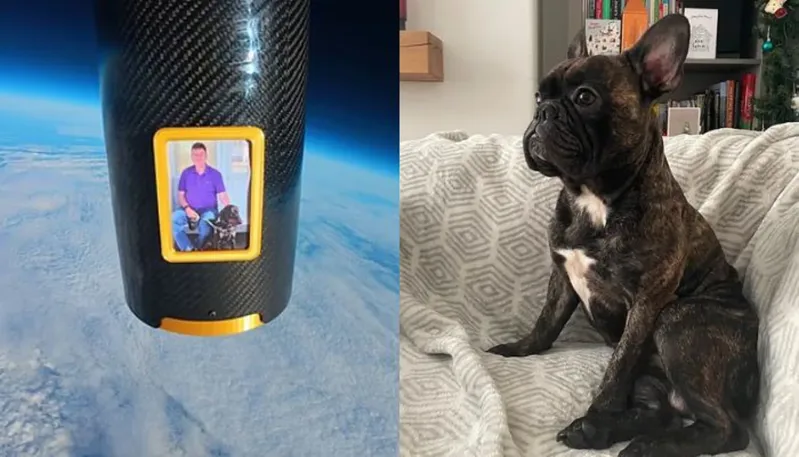
Oscar was six years old, blind, and had never seen the world he lived in. When brain cancer took him suddenly earlier this year, his owner Jacob Battersby didn't just want to say goodbye — he wanted to give Oscar the one thing his French Bulldog never got the chance to have: a view of it all.
So on May 7, Battersby and his collaborator Callum King strapped Oscar's ashes, his favourite Toy Story alien plush toy, a set of cameras, and a GPS tracker to a weather balloon and launched it from a field in Rugby, England. The balloon climbed for hours, pushing through temperatures that dropped to -72°C, until it reached roughly 119,000 feet — nearly 23 miles up, well past where commercial aircraft fly and into the thin edge of the stratosphere where the sky turns black and the Earth's curve becomes visible. There, the balloon burst under the pressure difference, exactly as designed, scattering Oscar's ashes into the upper atmosphere before the payload parachuted back down 55 miles away in Nottinghamshire.
It nearly ended in heartbreak of a different kind. The payload stayed airborne far longer than the pair had planned for, and just as they were preparing to accept it was lost for good, the GPS tracker pinged back to life with a location. They recovered it that same day.
King, reflecting on the tribute, said the idea was born from Oscar's blindness — the two wanted to show Oscar the world he'd never been able to see for himself, calling the launch his "last adventure." Battersby said he liked knowing that a part of Oscar is now, quite literally, in the sky — pointing out that people already tend to look upward when they think of someone they've lost. Eventually, he noted, Oscar's ashes will return to Earth the way most atmospheric particles do: through rainfall over the coming months, scattered wherever the weather carries them.
A Small Trend With a Bigger Story Behind It
Sending a loved one's remains skyward isn't new — human "space burials" using small satellite payloads have existed commercially for years, at a cost that runs into the thousands of dollars per gram. What's notable about Oscar's send-off is how it flips that model: a homemade weather balloon, built with a GPS tracker the pair were simultaneously stress-testing for their tech venture, doing on a hobbyist budget what the space-burial industry charges a premium for.
It also sits inside a broader, quietly serious shift in how pet loss is treated. Veterinary and psychology research over the past decade has increasingly validated what pet owners have long known instinctively — that grief for a companion animal can be as intense and disruptive as grief for a human family member, and that ritual and memorial matter just as much in processing it. Oscar's case adds a specific medical footnote to that pattern too: brain tumours are disproportionately common in French Bulldogs and other short-skulled ("brachycephalic") breeds, a consequence of the same flattened skull structure that also drives their well-documented breathing problems — a detail that gives this particular loss a harder edge than "sudden illness" alone suggests.
None of that makes the balloon launch any less whimsical on its surface. But underneath the viral, feel-good framing is a small case study in something more universal: how far people will go, and how creatively, to make an ending feel like it means something.