
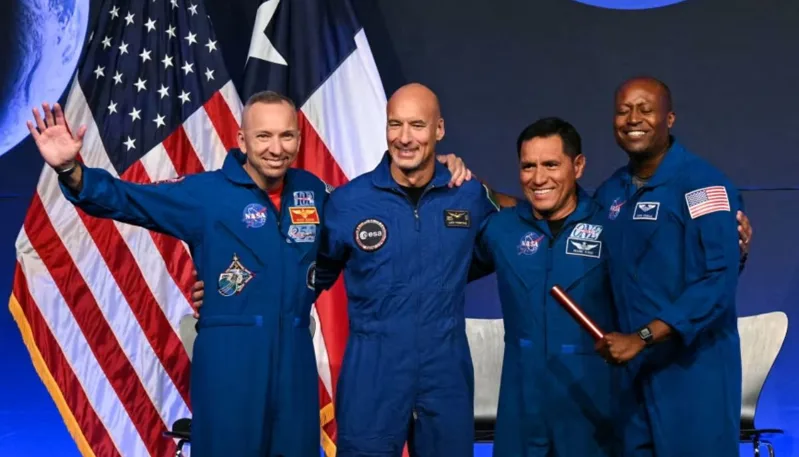
NASA has unveiled the four astronauts selected for its Artemis III mission, but excitement surrounding the long-awaited return to deep-space exploration is being overshadowed by growing concerns that key equipment may not be ready in time.
The American space agency announced on Tuesday that four astronauts will take part in the Artemis III mission, currently scheduled for launch in 2027. The mission is expected to play a crucial role in NASA's broader goal of returning humans to the Moon for the first time in more than half a century.
Among the crew is NASA astronaut Andre Douglas, who is set to make his first journey into space. He will be joined by veteran NASA astronauts Frank Rubio and Randy Bresnik, as well as Italian astronaut Luca Parmitano from the European Space Agency.
However, questions remain about whether the mission can stay on schedule. NASA's Artemis program has already faced multiple delays, and fresh concerns have emerged after an audit by the agency's Office of Inspector General warned that next-generation spacesuits being developed by private contractor Axiom Space may not be ready before 2028.
The uncertainty comes as NASA pushes ahead with preparations for Artemis III, which is expected to test critical technologies needed for future lunar exploration. The mission's current plan calls for astronauts to launch from Florida aboard NASA's Orion spacecraft and conduct a docking rehearsal in low Earth orbit with a lunar lander. SpaceX is developing its Starship vehicle for the Artemis program, although NASA has yet to confirm which contractor's lander will ultimately be used for the mission.
NASA previously opened the competition to multiple commercial partners, with the company that meets the agency's readiness requirements expected to secure the flight opportunity. While the astronaut announcement marks another milestone for Artemis, the success of the mission may ultimately depend on whether the technology designed to carry and protect astronauts can keep pace with NASA's ambitious timeline.
For now, the crew has been named. Whether they fly on schedule remains one of the biggest questions facing America's return to the Moon.