
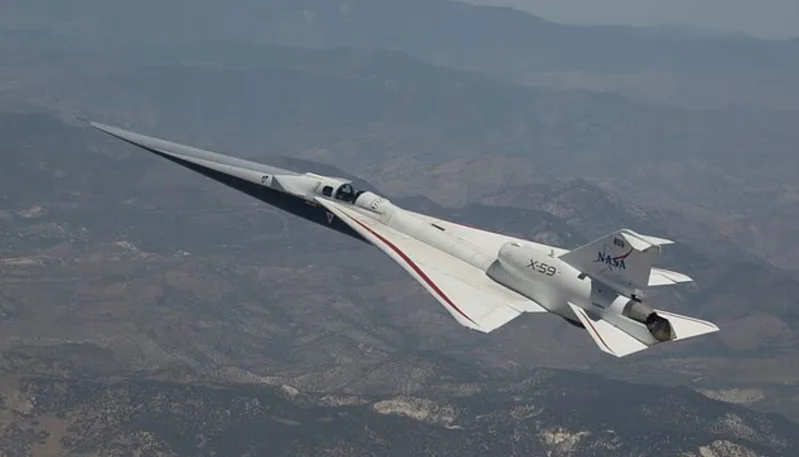
NASA is preparing to take a major step toward reviving one of aviation’s most ambitious ideas: quiet supersonic flight over land.
Its experimental aircraft, the X-59, nicknamed the “Son of Concorde,” is designed not just to break the sound barrier—but to fundamentally change how people on the ground experience it.
Instead of the sharp, window-shaking sonic boom associated with supersonic jets, the X-59 is built to produce what engineers describe as a soft “thump”. That difference may sound small, but it could determine whether supersonic passenger travel ever returns to commercial skies.
Why the X-59 matters more than speed
For decades, supersonic flight has been trapped by one major problem: noise.
The original Concorde could fly faster than sound, but its sonic boom was so disruptive that most countries banned it from flying over land. That limitation made routes inefficient and ultimately unprofitable.
NASA’s X-59 is trying to solve that exact problem.
Rather than focusing on raw speed alone, the aircraft is designed around a different goal:
make supersonic travel acceptable to people on the ground.
If successful, it could reopen the door to flights that cut long-haul travel times nearly in half.
How NASA is trying to “silence” a sonic boom
The X-59 doesn’t eliminate the shockwave of breaking the sound barrier—it reshapes it.
Its unusual design plays a key role:
- A long, needle-like nose spreads shockwaves over a larger area
- A carefully shaped fuselage prevents pressure from building into a loud boom
- Engine placement and airflow design are tuned to reduce sudden air compression
- The cockpit has no forward window; pilots rely on an external vision system instead
Together, these changes aim to transform a violent pressure wave into a much quieter sound signature.
NASA calls this approach Quiet SuperSonic Technology (Quesst).
What happens next in testing
The aircraft has already completed extensive ground and low-speed flight testing. The next phase focuses on pushing it closer to full supersonic conditions.
NASA’s planned flight profile includes:
- Initial flights around 630 mph at high altitude
- Gradual expansion toward Mach 1.4 (~925 mph)
- Final testing up to Mach 1.6 (~1,218 mph) at around 60,000 feet
But the most important part of the program isn’t speed—it’s measurement.
NASA will fly the X-59 over selected communities in the United States to record how people perceive its sound. Instead of relying only on engineering data, the agency is testing a crucial question:
What does “acceptable noise” actually sound like to the public?
That data could directly influence future aviation regulations.
The bigger picture: what success would unlock
If the X-59 works as intended, it could reshape commercial aviation in three major ways:
1. Faster global travel
Routes like New York to London could drop from 7+ hours to around 3–4 hours.
2. New aircraft designs
Manufacturers like Lockheed Martin and others could develop commercial jets based on the same “low-boom” principles.
3. A regulatory shift
Current bans on overland supersonic flight could be reconsidered if noise thresholds are proven acceptable.
Why this isn’t just another experimental jet
The X-59 is not being built to carry passengers or set speed records.
Instead, it is essentially a test case for a future industry that does not yet exist.
If successful, it won’t just be NASA achieving a technical milestone—it will be the first real step toward making supersonic passenger travel routine again, decades after the Concorde was retired.
Bottom line
The X-59 represents a shift in aviation thinking: from “how fast can we go?” to “how quietly can we get there?”
And if NASA’s experiment works, the next generation of air travel might not just be faster—it could be nearly silent too.