
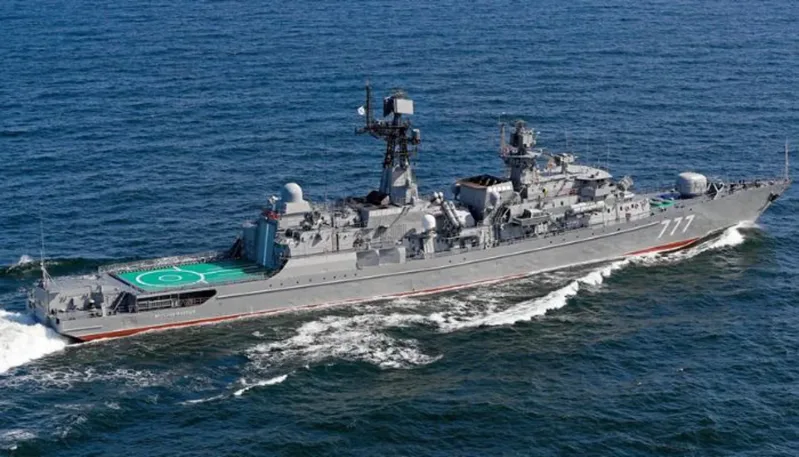
A Russian warship staged a live-fire exercise barely 40 nautical miles off Britain's Devon coast on Monday, timing that could hardly have been more pointed: it happened on the very day Andy Burnham took office as the UK's new Prime Minister.
The vessel involved, the Neustrashimy — a Baltic Fleet frigate whose name translates roughly to "Dauntless" or "Fearless" — was shadowed throughout by the Royal Navy patrol ship HMS Tyne. According to the Ministry of Defence, the Russian crew radioed the Tyne ahead of time, informing the British ship of its intention to fire and asking it to move to a safe distance. The exercise ran for roughly 30 minutes in international waters, and the MoD said the Navy tracked it closely from start to finish while affirming it stood "ready to protect UK national security."
Technically, nothing here breaks the law. International waters are international waters, and live-fire drills in them are not new. But the optics are the story: a Russian warship known for carrying a serious payload — a 100mm deck gun, Kashtan close-in weapons systems, and dozens of surface-to-air missiles — chose to demonstrate that firepower within sight of a major UK naval city, on the day a new premier walked into Downing Street.
Part of a Pattern, Not an Isolated Incident
This is where the deeper story lies. Monday's drill is not a standalone event — it's the latest in a string of Russian naval moves near British waters over the past several weeks. In June, the frigate Admiral Grigorovich reportedly fired warning shots near a British-flagged yacht sailing between the Isle of Wight and Normandy, an episode the previous prime minister, Keir Starmer, called reckless and "deeply concerning." Around the same time, British authorities intercepted a tanker from Russia's so-called "shadow fleet" — vessels believed to be quietly moving sanctioned Russian oil — in the English Channel, a first for the UK.
Taken together, the pattern points to a deliberate strategy rather than coincidence: probing, low-intensity naval activity designed to test response times, unsettle a new government, and remind London that Russia can operate close to home without technically crossing a line into confrontation. It's a page from a familiar playbook — the kind of grey-zone signalling Moscow has used elsewhere, short of anything that would trigger a NATO Article 5 response, but loud enough to make headlines and rattle nerves.
Why This Matters Beyond Britain
For readers well outside the UK, this isn't just a European security footnote. Naval brinkmanship in the English Channel and North Atlantic feeds directly into the same global tensions shaping energy prices, shipping insurance costs, and diplomatic alignments worldwide — including the calculus around Russia's ties with countries across South and Central Asia. Every time Moscow signals it can operate unchallenged near NATO's doorstep, it strengthens its negotiating position elsewhere, from energy contracts to arms deals, and reinforces the broader narrative of a multipolar order where Western deterrence is being tested in real time.
It's also a live case study in how quickly a new government's foreign policy credibility can be tested — not in a white paper or a parliamentary debate, but in the number of nautical miles a foreign warship is willing to sail toward your coastline on your first day in the job.