
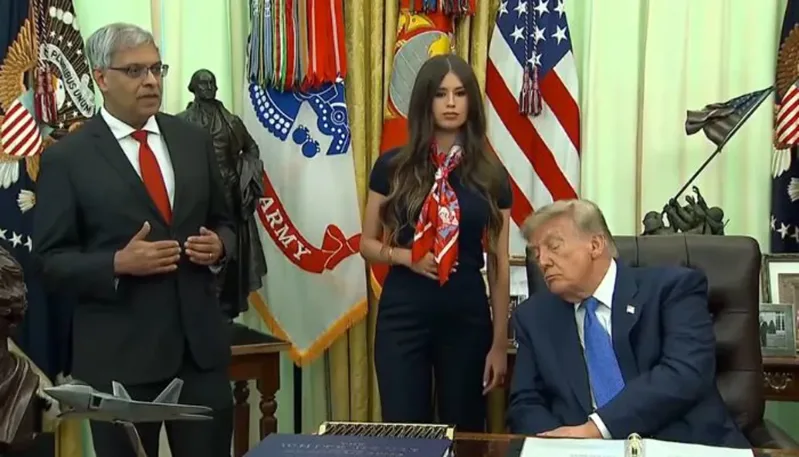
President Donald Trump signed an executive order Monday directing a major overhaul of America's childhood vaccine recommendations — trimming the list of routinely recommended vaccines from 18 diseases to 11, pushing the remaining 7 into a category left to individual doctor-parent discussion, and calling for the combined measles-mumps-rubella (MMR) shot to be split into three separate single-disease injections given at different visits. Health Secretary Robert F. Kennedy Jr. stood alongside him as he signed it.
Titled "Delivering Gold Standard Childhood Vaccine Recommendations for Americans," the order also directs federal health officials to develop standalone measles, mumps, and rubella vaccines — notable because those individual-disease shots aren't currently manufactured or available in the United States at all, meaning the order calls for a product that doesn't yet exist before its central recommendation can even be implemented as written.
The Administration's Case
The White House frames the change as bringing the U.S. in line with international peers, pointing to a January 2026 Department of Health and Human Services assessment that found American children are recommended more vaccine doses than children in any other developed country — 84 doses across 57 shots covering 18 diseases as of 2024, up from just 23 doses across 7 shots for 7 diseases in 1980.
Trump repeatedly connected the order to autism while signing it, acknowledging "we do not know" the exact cause while calling for what he described as the "best vaccine recommendations in the entire world." That connection is worth addressing directly rather than passing over: extensive, large-scale scientific research conducted over more than two decades — including major population studies involving millions of children across multiple countries — has consistently found no causal link between vaccines and autism. That isn't a matter of ongoing scientific dispute; it's one of the most thoroughly studied questions in modern public health, with a settled evidence base. The order's framing revives a claim that credible medical and scientific research has repeatedly failed to substantiate.
The Pushback
The reaction from the medical establishment was immediate and largely unified in opposition. Senator Bill Cassidy — a physician and the Republican chair of the Senate health committee — issued an unusually blunt public rebuke of a fellow Republican president, stating plainly that vaccines are safe, do not cause autism, and that the president lacks the medical expertise to be making these particular changes. Major medical organizations have separately noted that vaccines are already among the most extensively studied medical interventions in existence, making the order's call for "more research" somewhat at odds with the existing scientific record rather than filling a genuine evidence gap.
What Actually Changes — and What Doesn't
It's worth being precise about the order's real legal reach, because the headline framing can overstate its immediate effect. Vaccination requirements for schoolchildren are set by individual states, not the federal government — meaning Monday's order cannot, by itself, force any change to what vaccines a child actually needs to attend school anywhere in the country. What the order does is advise states with existing school vaccine mandates to consider revising their laws to match the administration's new preferred schedule — a recommendation, not a mandate, leaving the real-world impact dependent on whether individual state legislatures and health departments choose to follow Washington's lead.
Monday's signing is also not a standalone event — it follows a December 2025 directive in which Trump ordered HHS to review how peer nations structure their own vaccine recommendations, with this order representing the outcome of that review process playing out roughly eight months later.
The Backdrop This Is Landing Against
The timing carries its own weight. The order arrives amid a significant U.S. measles resurgence: 2026 has already seen 38 new measles outbreaks nationally, prompting officials to review whether the country still qualifies for its "measles elimination" status — a designation the U.S. earned in 2000 and has held for a quarter-century. Splitting the MMR vaccine into three separate shots at separate visits, as the order calls for, would mean a longer window during which a child remains only partially protected against measles, mumps, and rubella individually rather than covered against all three simultaneously — a structural trade-off public health experts have flagged as a genuine practical concern for outbreak response, independent of any dispute about the underlying safety of the vaccines themselves.
For readers following this from outside the U.S., the story is a useful case study in how domestic political pressure can shape formal health policy even where scientific consensus has not shifted — and one worth watching for how many individual U.S. states actually choose to follow federal recommendations that, on childhood vaccination specifically, they are under no legal obligation to adopt.
This is a developing policy story; if you or someone you know has questions about vaccine safety or scheduling, a licensed pediatrician or public health provider remains the most reliable source for individual medical guidance.