
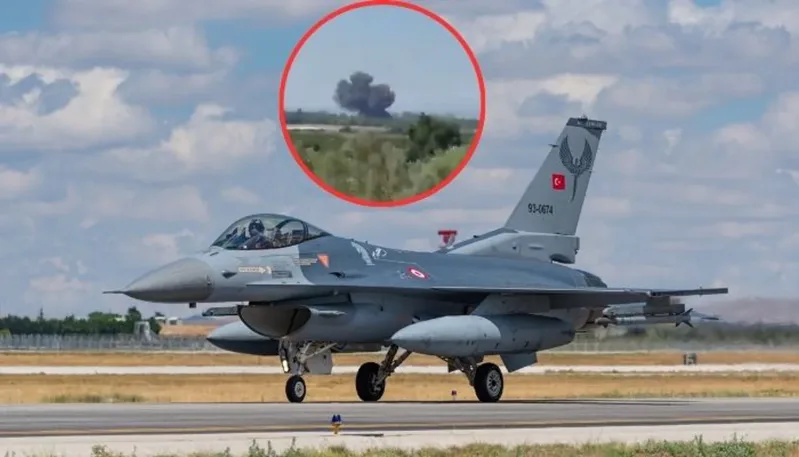
A Turkish Air Force F-16 crashed during a routine training flight over Yalova province in northwestern Turkey on Wednesday. The pilot ejected safely and was taken to Yalova Training and Research Hospital, where local reports describe their condition as good. Turkey's Defense Ministry confirmed the crash in a brief statement, saying the cause will be determined following a detailed investigation, and emergency crews were dispatched to the site near the Air Force's 18th Air Base. Video circulating on Turkish media showed a plume of black smoke rising from a field at the crash site.
Not an Isolated Incident This Year
What makes Wednesday's crash worth more than a routine incident report is timing: it's the second Turkish F-16 to go down in 2026. In February, a Turkish F-16 assigned to the Balıkesir 9th Main Jet Base Command crashed shortly after takeoff on a mission flight, this time with a fatal outcome — the pilot, identified by the Defense Ministry as Major Ibrahim Bolat, was killed, and debris from the crash forced a temporary closure of a section of the major highway connecting Istanbul and Izmir. Turkish prosecutors opened a separate investigation into that incident alongside the Defense Ministry's own inquiry.
Two crashes within six months doesn't necessarily indicate a systemic problem on its own — military aviation carries inherent risk, and training flights in particular are where mechanical faults or pilot-error incidents are statistically more likely to surface, precisely because that's where aircraft are pushed through maneuvers and scenarios closer to their operational limits. But the repetition is enough to make Wednesday's crash a legitimate data point in a broader conversation about the health of Turkey's F-16 fleet, rather than a one-off headline.
Why Turkey's F-16 Fleet Carries Extra Scrutiny
That conversation has a specific backdrop worth understanding. Turkey operates one of the largest F-16 fleets outside the United States, but its relationship with the aircraft has been unusually complicated in recent years. Ankara was removed from the F-35 stealth fighter program in 2019 after it purchased Russia's S-400 air defense system — a NATO-straining decision that effectively locked Turkey out of the alliance's next-generation fighter and left its air force more dependent on an aging F-16 fleet for longer than originally planned. Turkey has since pursued a major F-16 modernization effort, including a long-negotiated deal with Washington for new F-16 Block 70 aircraft and upgrade kits for its existing fleet, partly to offset the F-35 gap and partly because many of its current airframes are decades old.
Older airframes flying more intensive training and operational tempos — Turkey has used its F-16s extensively in operations along its Syrian border and against Kurdish militant targets in Iraq in recent years — naturally face more mechanical wear than a comparatively younger fleet, which is one of several plausible contributing factors investigators may weigh, though it's important to note neither Wednesday's nor February's crash has had an official cause confirmed yet.
What Happens Next
Turkey's Defense Ministry has not indicated any broader grounding or fleet-wide safety review following Wednesday's crash, and describing the pilot's survival as the immediate, most important outcome remains the accurate framing of the incident itself. The formal investigation into what caused the aircraft to go down will likely take weeks to complete, following standard military aviation accident investigation protocol — and its findings, once released, will be the detail worth returning to, particularly if any mechanical or maintenance-related cause connects it to February's fatal crash rather than the two incidents being entirely unrelated.