
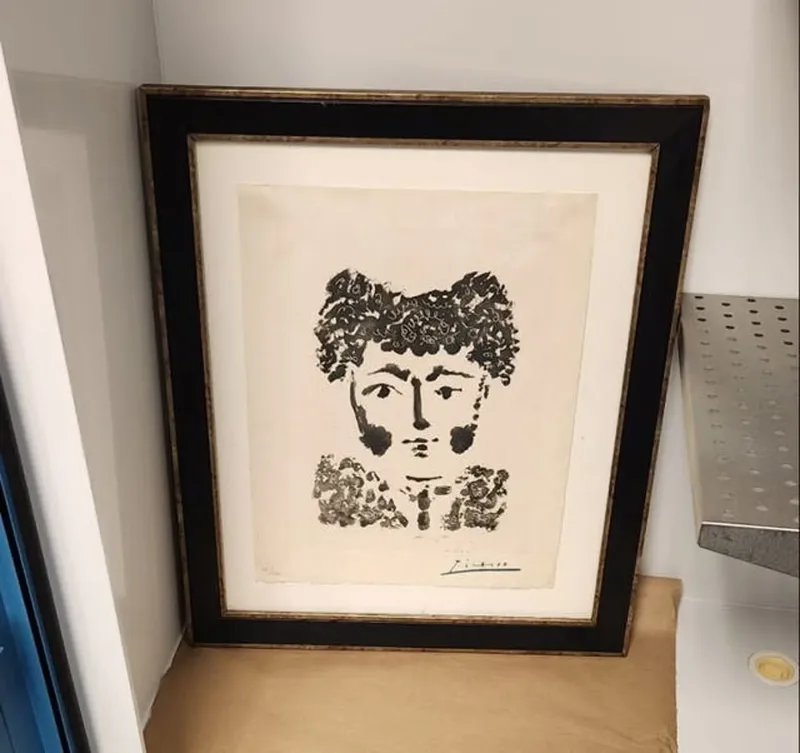
For eight years, Bill DeLind and Michael Goforth had accepted that Torero — a signed 1949 Picasso etching that once hung proudly in the lobby of their Milwaukee appraisal firm — was gone for good. Then, on Wednesday, a Milwaukee Police District Four officer looked up to find a community member walking in with an etching print, suspecting it might be the missing piece. An authenticator confirmed it the very next day: it really was Torero, back after eight years, three months, and roughly three weeks of disappearance.
"It was like, 'Oh my God,'" DeLind told local reporters. "I never thought I'd see this again. And there it was."
What Actually Happened in 2018 — and What Still Hasn't
The theft itself was almost comically low-tech for something worth up to $50,000. On February 16, 2018, someone walked into the lobby of DeLind Fine Art Appraisals on North Jefferson Street, lifted the etching off the wall, and walked back out — during business hours, with no security cameras running, and without anyone noticing until Goforth stepped off the elevator and saw a blank space where the black-framed print had hung. DeLind later told reporters the thief may not have even known what they were taking: the gallery had no price tags or artist labels on display, meaning whoever took it may simply have gotten lucky with an appealing frame.
What police still haven't explained, even now, is the other half of the mystery: who returned it, and where it had been for eight years. Milwaukee police confirmed only that an unidentified community member brought the piece to District Four on August 5, and that investigators are now working to establish the artwork's chain of custody and locate its rightful owner — DeLind's firm having presumably filed an insurance claim in the intervening years, which can complicate who legally owns a recovered piece once a payout has already been made.
Why This Kind of Theft Almost Never Pays Off
The case is a small but genuine window into why high-value, well-documented stolen art is such a poor target for casual theft, whatever a thief might assume walking past a nicely framed piece in a window. Torero is the ninth print in a limited edition of just 30, each individually signed by Picasso in green crayon — meaning it's about as traceable an object as a criminal could choose to steal. Within weeks of the 2018 theft, the piece had already been registered with major stolen-art databases in London and New York, the same registries galleries, auction houses, and serious collectors routinely check before any legitimate sale. That registration effectively freezes an artwork out of the legal market indefinitely: any attempt to sell, insure, or publicly display it risks immediate identification, which is precisely why so much high-profile stolen art — including far more famous unsolved cases like the 1990 Isabella Stewart Gardner Museum heist in Boston — simply never resurfaces through ordinary channels. It sits in private hands, sometimes for decades, because there's effectively no safe way to cash it in.
Seen that way, this week's return may be less mysterious than it first appears. An anonymous handoff to police, with no reward claimed and no explanation offered, is a common pattern in stolen-art recoveries — often the artwork having passed through several hands since the theft, ending with someone who inherited or acquired it without knowing its history, recognized it once its story resurfaced somewhere, and chose the simplest way out: hand it back and walk away.
A Quietly Happy Ending, With Loose Ends
For now, Torero is back in police custody while investigators sort out ownership. DeLind and Goforth get their bullfighter etching back — or at least the promise of it — eight years after giving up hope. Milwaukee police, in a short statement, thanked the person who returned it: "We are better together." The identity of that person, and the eight years the print spent somewhere between a Milwaukee wall and a police station counter, may never be known at all.