
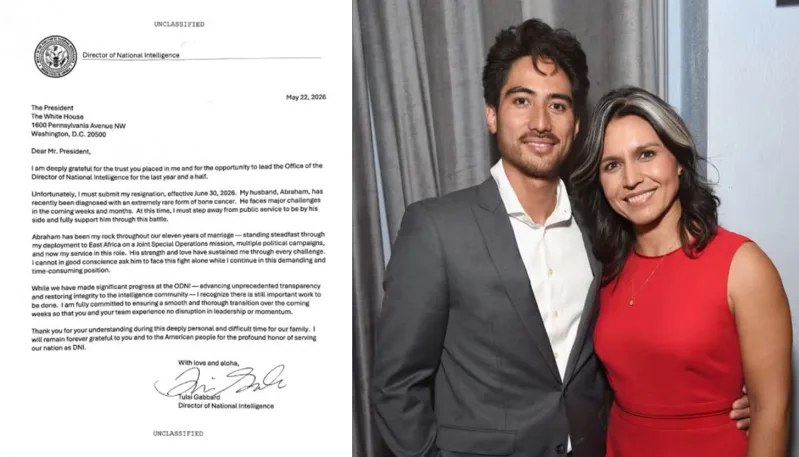
United States (U.S.) Director of National Intelligence Tulsi Gabbard announced her resignation from the Trump administration on Friday, citing her husband Abraham Williams’ serious health condition as the reason behind her departure after nearly 18 months in office.
The announcement immediately sparked widespread curiosity online about Williams, who has largely remained away from the political spotlight despite frequently accompanying Gabbard during major moments of her public career.
Who is Abraham Williams?
Abraham Williams is a cinematographer, camera operator and creative professional based in Hawaii. He is best known publicly as Tulsi Gabbard’s husband, but he has also worked extensively in video production and political media.
Williams and Gabbard married in 2015 in a traditional Hindu ceremony in Hawaii, an event that drew national attention because of Gabbard’s unique political profile and multicultural background.
Over the years, Williams played an active role behind the scenes in Gabbard’s political career, frequently helping with campaign visuals, photography and digital media production during her presidential run in 2020 and later political appearances.
Despite his association with a high-profile political figure, Williams has generally maintained a low public profile and rarely gives interviews.
What health condition does Abraham Williams have?
According to reports referenced by Gabbard in her resignation announcement, Williams was recently diagnosed with a rare form of bone cancer, a development that reportedly became the central factor in her decision to step away from one of the most demanding positions in the U.S. government.
Gabbard stated that her husband’s medical condition requires her “full time, energy and attention” during treatment and recovery.
While exact medical details have not been publicly disclosed, the diagnosis appears to have significantly altered the former intelligence chief’s personal and professional priorities.
Why did Tulsi Gabbard resign?
Gabbard announced her resignation in a social media post, saying family responsibilities had to come first amid her husband’s health battle.
Her departure ends a turbulent and highly scrutinized tenure under President Donald Trump, during which she emerged as one of the administration’s most unconventional cabinet-level figures.
A former Democratic congresswoman from Hawaii, Gabbard became one of Trump’s most surprising political allies after leaving the Democratic Party and endorsing him during the 2024 election cycle.
Her appointment as Director of National Intelligence drew both praise and criticism across Washington because of her past foreign policy positions and anti-interventionist views.
A controversial tenure in the Trump administration
During her time as intelligence chief, Gabbard often found herself at the center of political and national security debates involving:
- U.S. foreign policy
- intelligence reform
- surveillance oversight
- and tensions involving Iran, China and Russia.
Her critics questioned her approach to intelligence restructuring, while supporters viewed her as an outsider attempting to reform entrenched institutions inside Washington.
Reports in recent months suggested increasing friction between parts of the intelligence community and some officials inside the administration, although Gabbard publicly maintained that her resignation was solely tied to her husband’s medical condition.
Public reaction pours in
Following the announcement, politicians, commentators and supporters from across the political spectrum shared messages of support for Gabbard and her family.
Many social media users expressed sympathy for Abraham Williams after details of his diagnosis became public, while others praised Gabbard for prioritizing family over political office.
The White House also acknowledged her resignation and thanked her for her service in the administration.
What happens next?
Gabbard is expected to formally leave office later this summer, with an interim intelligence official likely to oversee the Office of the Director of National Intelligence until a permanent replacement is nominated.
Meanwhile, public attention has increasingly shifted toward Abraham Williams and the personal crisis that abruptly ended one of the most unusual political tenures in recent Washington history.