
In Pakistan’s crypto case, government has always been uncertain about its decisions. Sometimes it allows crypto then it doesn’t. Why does it keep flip-flopping between yes and no?
Let’s understand:
Suppose there was a young boy who always tried to find out short cuts for making money. Pakistan was that boy! Pakistani people found out about Bitcoin, a digital currency that runs entirely through computers. No bank supervision, no government control! In 2015-2017, people started buying this currency, sold it and made money using just their phones, a lot of it!
Crypto users in Pakistan grew in numbers rapidly because Pakistani Rupee was becoming weaker day by day due to inflation. People wanted to save money so they traded bitcoin.
The plot twist occurred in 2018. Government and State bank of Pakistan became afraid of capital flight (moving money outside of country in large amounts), money laundering, scams and terrorist funding. So SBP strictly prohibited banks from dealing in crypto. Due to this ban, crypto dealings were stopped officially but people kept using it secretly.
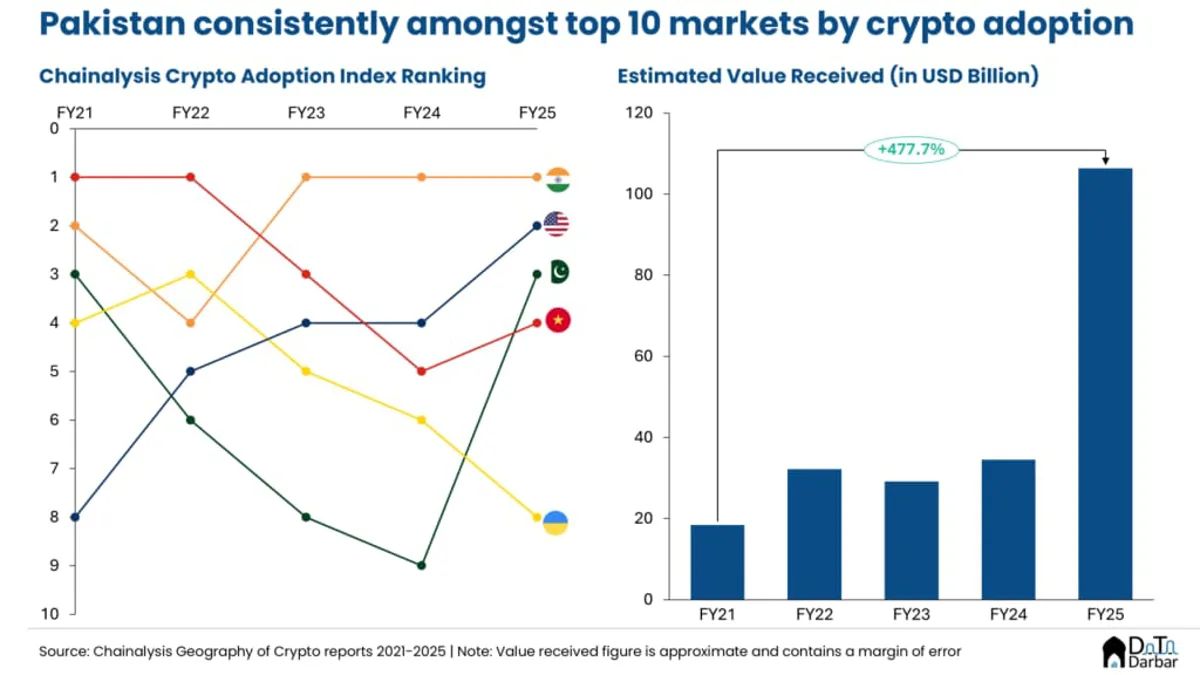
Between 2019 and 2024, government realized the ban was not working, and people were still using crypto. According to Chainalysis report, Pakistan is at #3 in top countries in the world in crypto adoption. In Pakistan there are almost 15-20 million users (so much more than stock market investors). The trading volume has reached $300 billion+ according to some reports.
But why this flip on government side again?
THE NEED FOR MONEY!
Pakistan needs foreign investment and taxes and crypto creates new job opportunities and brings tech innovation.
It makes international transfers easier without high remittance fees.
International organizations demand rules and regulations to remove Pakistan from grey list so now the government which was afraid of ban before, now tries to regulate it under control.

In 2025-2026, Pakistan passed the Virtual Assets Act. A new authority; PVARA was formed with objectives to give license to crypto exchanges, make rules, and control scams. And now banks are allowed to deal with licensed crypto companies. Still there is a lot of confusion due to religious constraints especially with more scholars giving rulings like “completely haram” or some giving “partially halal”.
Overall Pakistan being #3 in world in crypto adoption shows people are interested in it, but the volume shows how big an unregulated market is. So the government is trying to regulate it under its own supervision because they cannot stop people. The least they can do is protect their people. Because when you can't stop the wave, the smartest move is to learn how to ride it!