
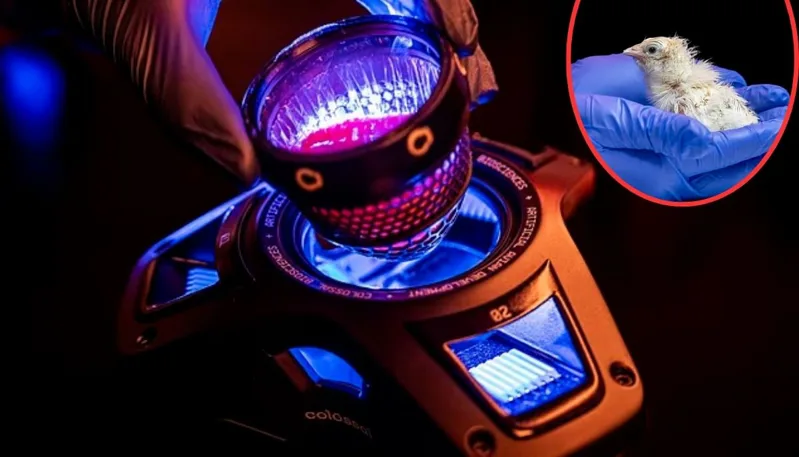
A new experimental breakthrough in biotechnology has sparked global attention after researchers reportedly developed an artificial egg-like incubation system that successfully supported the development and hatching of live chicks. Scientists say the work could open new possibilities in reproductive science and long-term bioengineering, including future artificial womb technologies.
The development comes from Colossal Biosciences, a U.S.-based biotechnology and genetic engineering company widely known for its ambitious work in de-extinction research and advanced species preservation projects.
Artificial Egg System Mimics Natural Development
According to researchers involved in the project, the team engineered a shell-less incubation system designed to replicate the biological conditions of a natural egg. Instead of relying on a traditional eggshell, the system uses a 3D-printed outer structure combined with a silicon-based membrane that allows controlled oxygen exchange, mimicking the protective and respiratory functions of a real egg.
Early-stage bird embryos were placed inside this controlled environment, where they were carefully monitored over an extended incubation period. Scientists say the embryos were supported through nutrient delivery systems designed to simulate natural developmental conditions inside an egg.
After approximately 18 days of incubation, the embryos reportedly developed into healthy chicks and successfully hatched from the system.
While the results are being described by the research team as promising, independent scientific verification and peer-reviewed publication of the findings are still awaited.
A Step Toward Artificial Womb Research
The research has been widely interpreted as an early step toward more advanced reproductive technologies, including the long-term goal of developing artificial womb systems capable of supporting full gestation outside a biological organism.
Scientists involved in similar fields of study say such technologies could eventually transform how certain species are bred, studied, or even preserved, particularly in cases involving endangered animals or conservation biology.
However, experts caution that moving from avian embryo incubation systems to fully functional artificial wombs for mammals or humans represents an enormous scientific leap that will require years, if not decades, of further research.
Company Highlights Broader Bioengineering Ambitions
Colossal Biosciences, the company behind the development, has previously attracted attention for its high-profile work in genetic engineering and efforts aimed at reconstructing extinct or near-extinct species using advanced biotechnology tools.
The company is currently engaged in multiple research programs focused on species restoration, conservation genetics, and synthetic biology applications.
In a statement attributed to the research team, the system was described as a significant advancement in bio-incubation technology, with one researcher reportedly saying the platform demonstrates how “life can be supported outside traditional biological structures under carefully controlled conditions.”
Potential Impact on Conservation and Endangered Species
Beyond theoretical reproductive science, researchers suggest that such incubation technologies could eventually play a role in wildlife conservation efforts.
One potential application includes supporting the survival of endangered bird species by improving hatch rates in controlled environments. Scientists argue that if refined further, the system could help address challenges faced by species with declining reproduction success in the wild.
However, conservation experts emphasize that the technology remains experimental and is not yet ready for real-world deployment in ecological programs.
Related Research and Scientific Context
Artificial gestation and incubation systems have been an area of growing scientific interest in recent years. Previous experiments in bioengineering have demonstrated partial success in sustaining mammalian embryos in artificial environments, though full external gestation remains a highly complex challenge.
The latest development adds to a broader scientific effort exploring how far biological development can be supported outside natural reproductive systems.
What Comes Next
Researchers say the next phase of development will focus on refining oxygen flow systems, nutrient delivery precision, and long-term embryo stability within artificial environments. Further testing and scientific validation will be required before the technology can be considered reliable or scalable.
While still in its early stages, the breakthrough has already ignited discussion in scientific and public circles about the future of reproduction, conservation, and bioengineering.
For now, experts agree that the work represents an intriguing step forward — but not yet a replacement for natural reproductive biology.